


Distance: 127km
Elevation: 2.786m
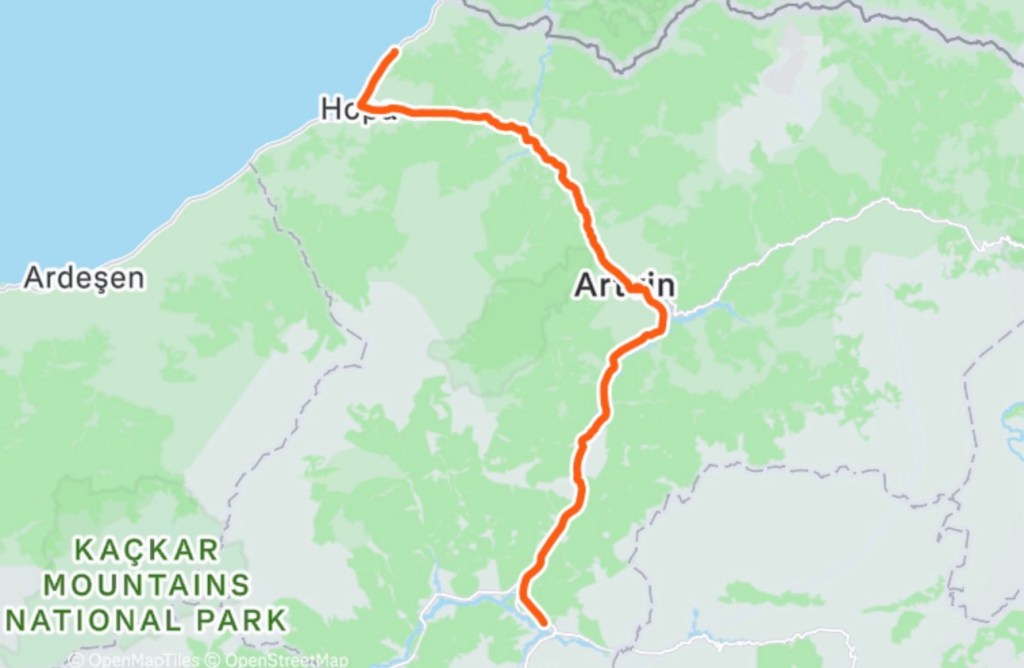
Esenkıyı: https://maps.app.goo.gl/XYVFoFaT6VQxgLdM7?g_st=ic
I woke up as the sun came up. I made coffee and sat in my little chair. The sun was slowly illuminating the tips of the rocks and mountains around me. It was a beautiful sight. I took my time.

Finally, I packed up and was on the road by quarter past eight. Just in time. A few minutes later, the workers returned to their worksite.
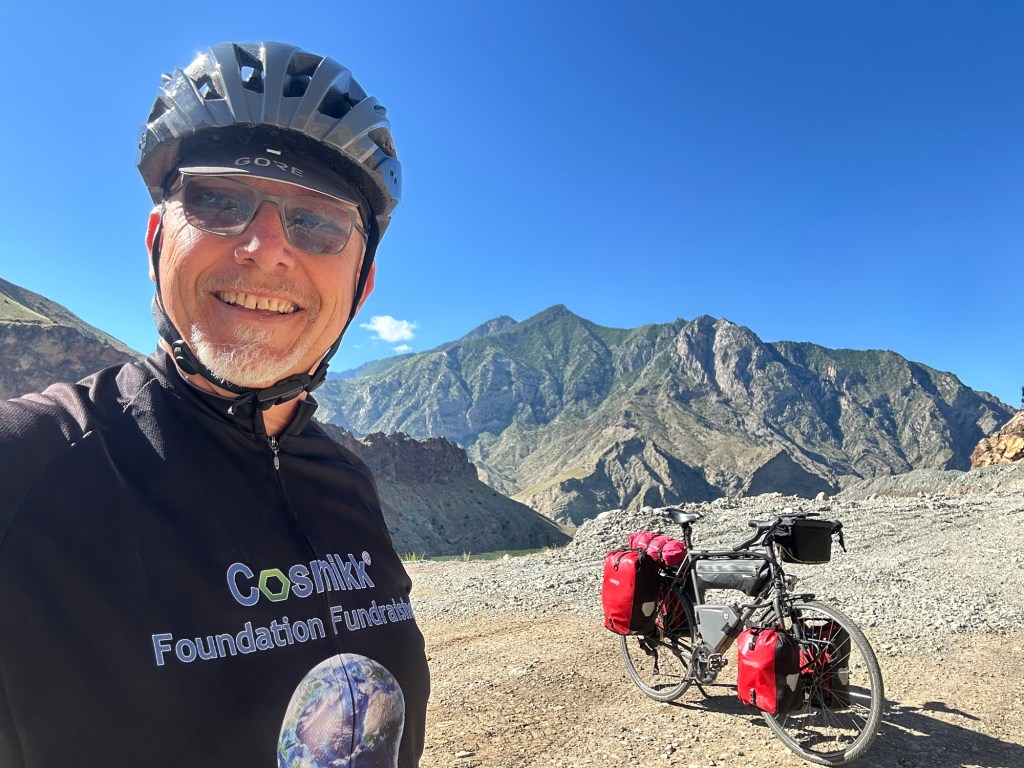
It turned out to be the day of tunnels. I cycled through somewhere between fifty and sixty of them. They ranged from two hundred meters to five kilometers long. Often I would exit one tunnel and enter the next almost immediately. There was barely a gap between them.

The tunnels were good quality. Most of them were lit. The tarmac was solid. But the shoulders were narrow, as they always are. After a while, my nervous system adjusted to the sound. The waves of noise from passing cars and trucks — first from one direction, then the other — became less alarming.
I also noticed a practical upside. I had run out of sunscreen. Cycling through tunnels is, it turns out, excellent sun protection.
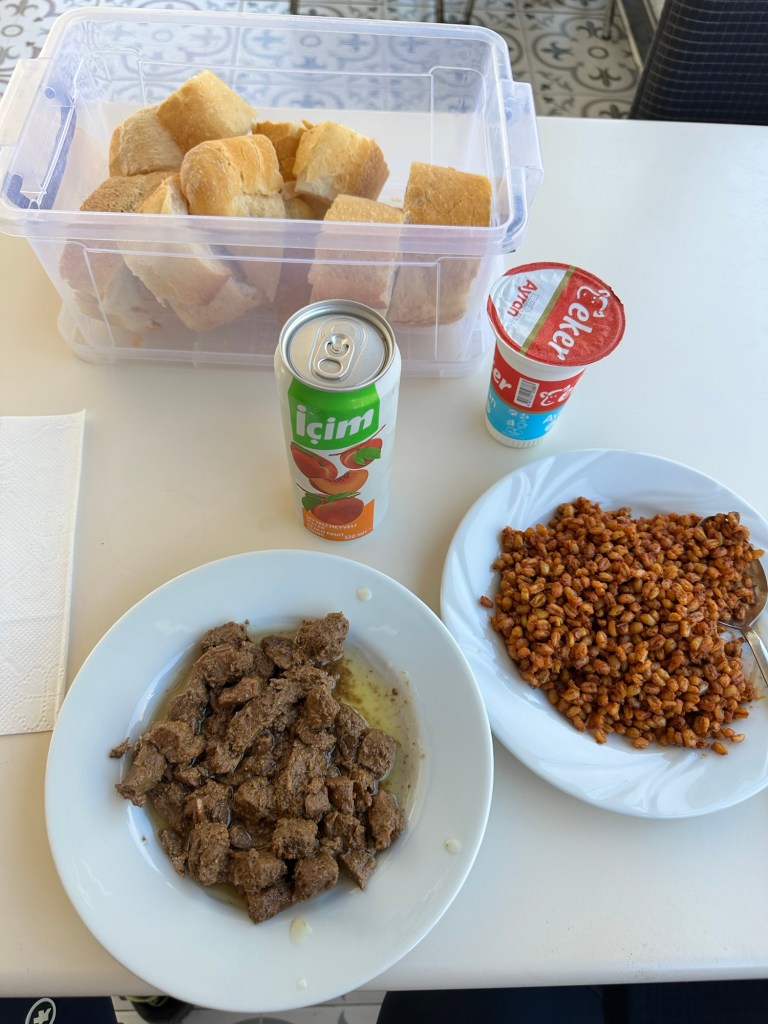
It got hot. When I saw a gas station or a roadside restaurant, I stopped and had something to drink or to eat.
The scenery today was a step down from yesterday. The Çoruh River, which carves through the canyon, has been tamed by a series of hydroelectric dams. The result is a heavily industrialized valley. Trucks went in both directions at high speed. Turkish truck drivers appear to have sworn an oath never to brake for anything smaller than themselves. In general, everything went fine through and nothing got too scary.
Where the river once ran free, it now backs up into long reservoir lakes. Floating fish farms have been set up across the water in circular formations.

So there was still plenty to look at. Just not as breathtaking as the day before.

Around noon, strong headwinds started to build up again. At certain corners it felt like cycling into the warm air from a hair dryer. I switched into „broccoli mode“. That means: don’t think, don’t feel, just pedal in a low gear and don’t waste energy on anything else. Slowly but surely, kilometer by kilometer, I covered the distance.
Artvin had been my intermediate goal for the day. It turned out to be a pretty ugly industrial place. The many mines and quarries operated in the area give work to the people here and shape the look of the place. I stopped at a gas station for a break, had a short chat with the attendant, a marathon runner who spoke some English, and then decided to pedal on and complete the remaining sixty kilometers to Hopa and the coast of the Black Sea.
Although the route was technically downhill from Artvin, there were so many climbs tucked into it that this became the day with the highest elevation gain of the tour so far. It was tough. But also beautiful.
Near Hopa, I came across a young motorcyclist, Tafun was his name, with a broken-down bike and a phone with no credits left. He asked if I could help. The old Boy Scouts rule kicked in — one good deed a day. I lent him my phone so he could reach a family member to come and collect him and the motorbike.

Then I continued up the last steep incline, which led into a long tunnel going downhill toward the coast.
The tunnel had two separate tubes, one for each direction, which was good for my peace of mind. However, parts of it were pitch black. Have you ever tried to cycle with a small bicycle light and sunglasses into complete darkness? You immediately lose all sense of orientation. It took a while to adjust. Eventually the tunnel had light again, which was a considerable relief. The descent was steep. I hit fifty kilometers per hour. And then after almost 6km, the tunnel spat me out on the other side.
I was approaching Hopa. Only a few kilometers left. And then, for the first time in my life, I saw the Black Sea.
Hopa itself is not a pretty place, so it was easy to cut straight through it. At the coast, I was met by a line of trucks stretching as far as I could see. Several hundreds of them waiting to cross into Georgia. I passed them all and cycled another eight kilometers along the coastline, enjoying the view, before reaching a campsite well known among cyclists and travelers. It sits directly on the sea. It also sits directly on the highway. It is fairly rundown. But the owner family is warm and welcoming. Whether you enjoy a place like this depends entirely on what kind of traveler you are.
I made friends immediately. A car with Saarbrücken plates caught my eye. I spoke to the owner. His name was … let’s say A. A man who has lived and worked in Germany for forty years, married to a German wife, father of three. He and his German Shepherd named Argus, spend the summers here in the Hopa region, where A. has a small bungalow surrounded by a tea plantation and a hut up in the mountains. As it turned out, he is childhood friend with the owner of the campground. He invited me to dinner with „the family“ and offered me a cold beer.
After a day like this, that was paradise and A. was an excellent host.
A. runs gambling machines back in Germany and has built a small business around it. His youngest child manages the operation when he is away. His two oldest are both doctors. A proud father and an independent entrepreneur.
He comes to the Hopa region partly because the rules here around how you spend your evenings are a little more relaxed than in other parts of Turkey. Later that night, he and his friend were heading to a nightclub and invited me to join. I have a rule of saying yes. I broke it. I was tired and simply not in the mood. Plus I am happily married and intent to keep it that way. They understood and left without me but not without inviting me for breakfast the next day.
When they had gone, I got into a political conversation with a friend of the family. I will call him M. He had been introduced to me as a retired politician who had returned to his hometown. He was someone critical of the current government, so I asked him what his main points of criticism were. Three things stood out. First, that the large infrastructure investments of the past twenty years — the roads, the tunnels, the bridges — had also been a vehicle for enriching Erdogan’s family and inner circle, either through the funds, the contracts, or both. Second, the high inflation, which had badly eroded the exchange rate and buying power of the Turkish lira. Thirdly, Erdogan had increased the international dependency of Turkey when it comes to importing product. And fourth, a set of theories about Erdogan being a secret jew and Turkey being effectively controlled by the US and Israel. This last part edged toward the kind of conspiracy thinking I had encountered in various forms all around the world. Here it came in a Turkish flavour, which made it no less interesting.
We had a lively discussion using ChatGPT as our translator, which worked far better than Google Translate. At some point his phone battery died. We took that as our cue to call it a night.
I went to sleep around half past ten. Despite the noise all around me, I crashed immediately.
Learnings of the day:
Conspiracy theories are local everywhere. The characters change, the villains change, the specific grievances change. But the structure is always the same. Someone powerful is secretly pulling the strings. Nothing that happens is accidental. Everything we see is show. This was one of a plethora of versions of this story I have heard on my tour around the world, each one shaped by a different context.
Conspiracy theories fill a gap in our crazy world. They offer clarity, a clear enemy, and the comfort of feeling like you know something others don’t.
Hi Karsten. As always it’s great to follow your path and your experiences. Congratulations that you successfully „made“ Turkey. Looking forwrd to learn about Georgia.