


Distance: 105km
Elevation: 706m

I left Kutahya around half past eight under a blue sky and in cool air. Most of the heavier climbing came in the first half of the day, which actually made it more enjoyable. The roads here are magnificent. Wide shoulders, good surface, and most drivers are careful and considerate. There are one or two who come dangerously close, but that is the case everywhere. The cars are also in better shape than I had expected. I had anticipated a lot of old vehicles, and while there are some Turkish models that look like something from the seventies, the overall picture is decent.
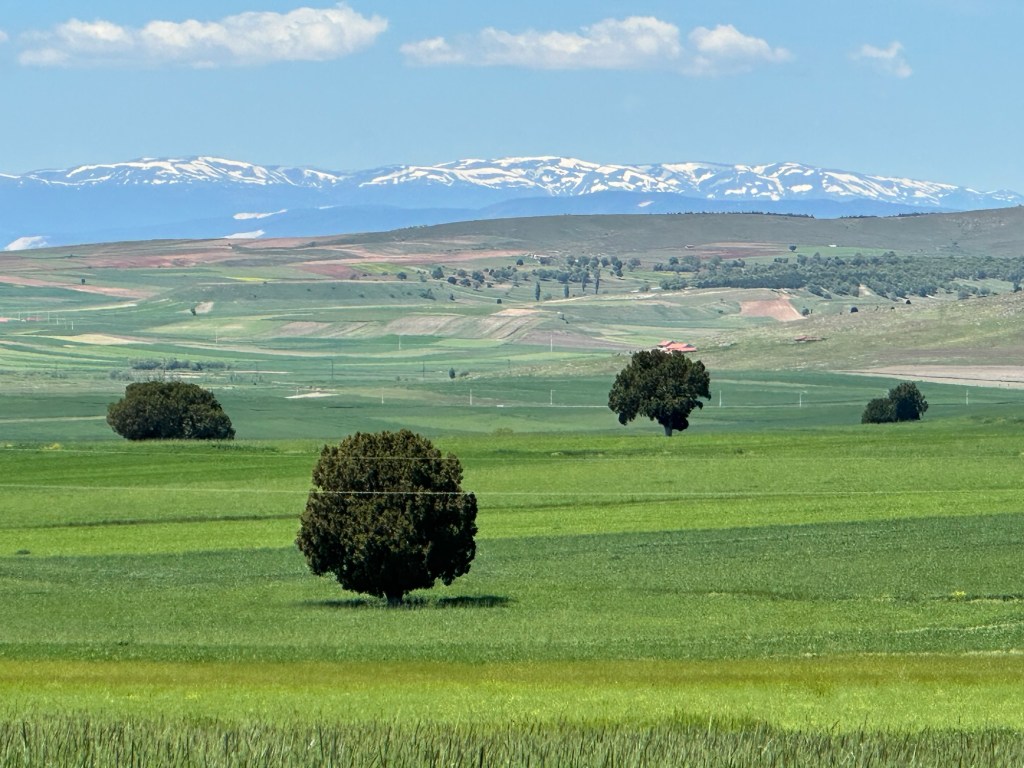
The route took me through rolling hills with wheat fields, rye, and many other plants I could not name. The green came in dozens of different shades and in the distance you could see snow covered mountains.
Along the roadside I noticed a plant that looked like wheat but was taller and more dramatic. It is called mullein, or Königskerze in German. It is supposedly rare back home, but it grows everywhere here.

One other thing I noticed: no stray dogs. Since leaving the cities, they have simply disappeared. Near the larger towns I had seen shelters built for them with food provided, which seems to be a deliberate policy to keep them out of the urban centres. Whatever the reason, the roads felt calmer without them.
After 70km, I had some Köfte in a village called Dogalar. I needed some energy for the final push.
Leaving Dogalar, the landscape changed in a way I had not expected. The road passed through rock formations that reminded me strongly of Drumheller in Alberta, Canada. Drumheller sits in the Red Deer River valley, where millions of years of erosion have carved the land into badlands: towers, gullies, and layered cliffs in reds, browns, and yellows, each stripe a different geological era. The area is one of the richest dinosaur fossil sites in the world, and excavations are still turning up bones today. What creates that landscape is a combination of volcanic deposits laid down tens of millions of years ago and the slow, relentless work of water cutting through soft sedimentary layers at different rates. The result is a surface that looks almost sculpted.
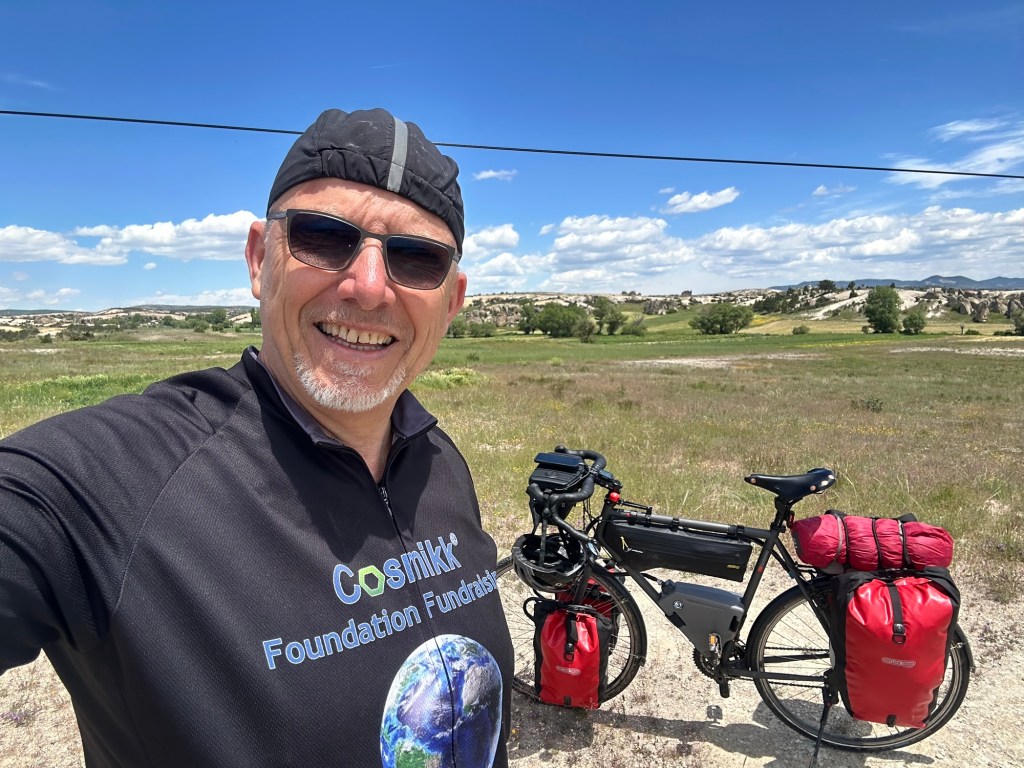
Whether it was the same volcanic episode at the root of it I cannot say, but the resemblance was striking. It was one of those stretches where you slow down without meaning to, just to keep looking.
As I got closer to Afyon Karahisar, I noticed something that had been shifting gradually over the last few kilometres without me quite registering it. In the villages and countryside, the women I passed were dressed traditionally, fully covered, long coats, headscarves, nothing left to chance. But as the outskirts of the city approached, the picture diversified. Within the space of a few kilometres you could see the full range, from women completely covered in the Turkish equivalent of a hijab to others in tank tops and bare arms. Both walking the same street, sometimes side by side. It struck me as a visible measure of a tension that must run deep in this society, between what tradition and religion prescribe and what a younger, more urban generation is choosing for itself.
I continued the last thirty-five kilometres into Afyonkarahisar, a city of around two hundred and fifty thousand people. I had booked a simple room in a hotel that had clearly seen better days. Despite leaving at a reasonable hour, I did not arrive until five in the afternoon. I stayed in, did some research, answered emails, and was in bed by nine.
Tomorrow I will make another attempt at wild camping. We will see how that goes.