


Distance: 116km
Elevation: 769m
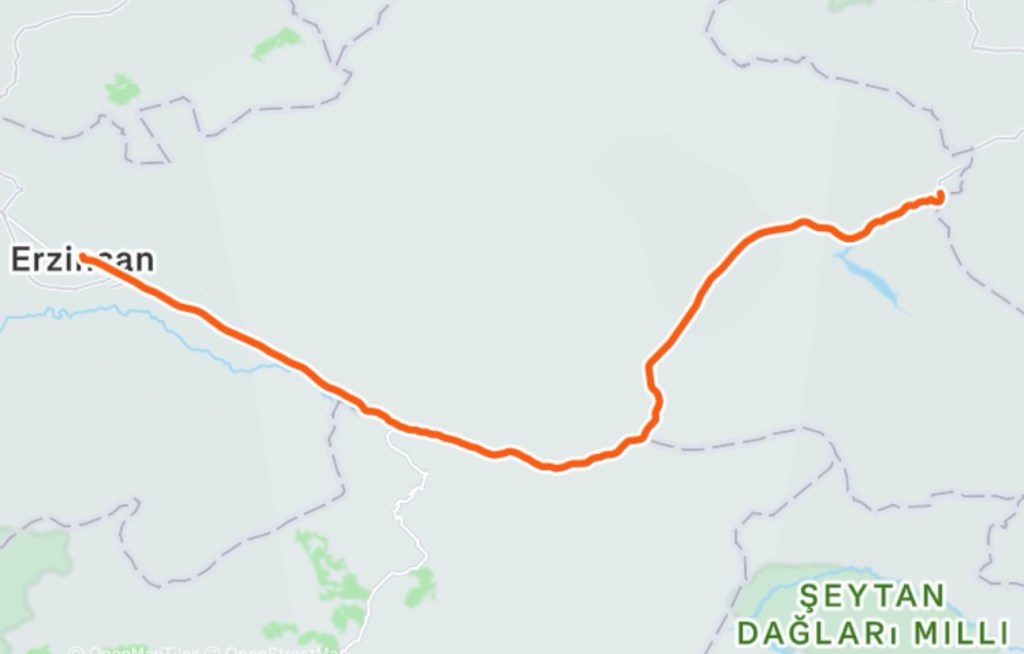
Mustafabey: https://maps.app.goo.gl/BMWyioCTp14GQsU78?g_st=ic
The most remarkable moments of my break day were a coffee chat with my wife in the morning, a lunch with T., and dinner with „John“. Both meals turned out to be very educational and interesting. Apart from that, it was a full work day. Many calls were about our new project with our Cosmikk Foundation in Uganda. This project is quite exciting. Stay tuned for more.
Over lunch, I went out. I left my slightly dubious hotel and found a nice restaurant nearby. The one waiter who spoke a little German took care of me right away. He ordered for me before I could say a word: a döner, a salad, and a glass of ayran. Delicious.
A little later, a man joined my table. He introduced himself, let’s call him T. and told me he grew up in Germany since he was eleven years old. But originally, he was from Erzincan. Today he works in the pharma industry in Germany. He is also an artist. He composes contemporary music in Turkish, and he had come to Erzincan to meet a videographer. They wanted to record his latest music video in an abandoned village.
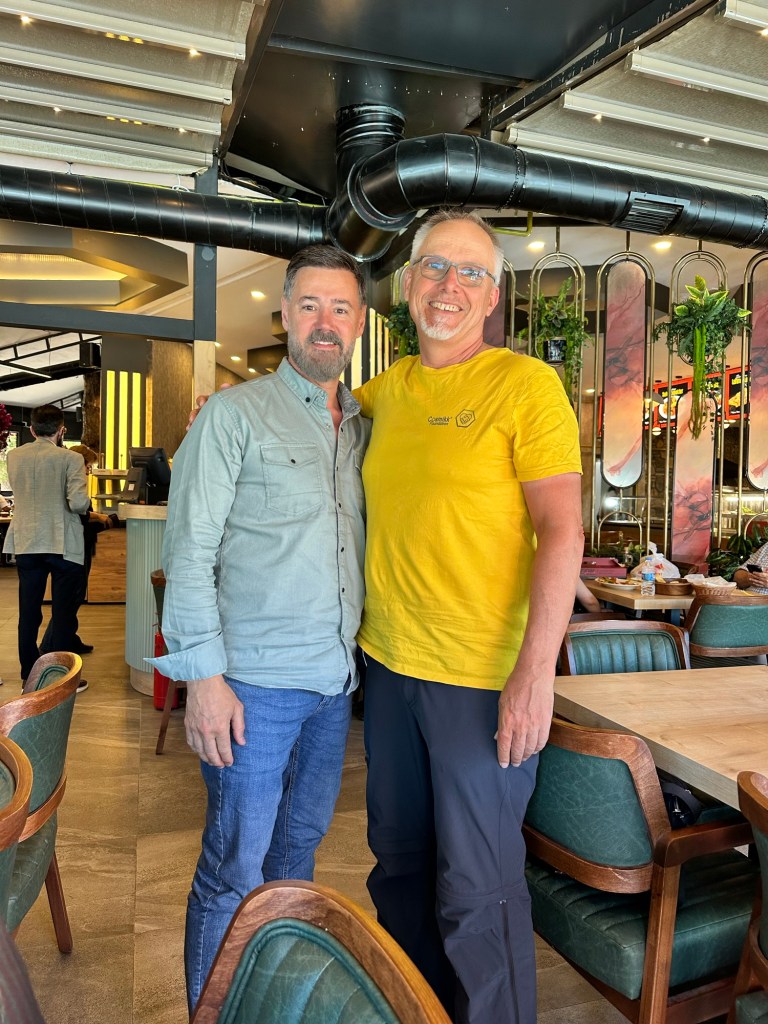
He had figured out I was German because people in the restaurant kept saying “Alman, Alman” while looking at me. So I invited him to sit down, and we had a very interesting conversation.
He told me that Erzincan was almost completely destroyed by an earthquake in 1992. The city which was originally closer to the River Euphrates was rebuilt a few hundred meters away from the fault line, completely from scratch. The remains of the old city were demolished, and the gap in the ground was filled in.
He also told me that he belongs to the Alevi community. I wanted to know more about that.
Claude overview of the Alevi community in Turkey, added for background:
The Alevis are one of Turkey’s largest religious minorities, making up roughly ten to twenty percent of the population. Their faith blends elements of Shia Islam with pre-Islamic Anatolian, Turkic, and Sufi traditions. Alevis do not worship in mosques. Instead, they gather in community houses called cemevis for ritual ceremonies that include music, poetry, and a ceremonial dance called the semah. Men and women take part together, which sets Alevism apart from many Sunni practices.
Alevis follow Islam in their own way. Most Alevis do not follow the five pillars like Sunni Muslims do. They do not pray five times a day in the Sunni style, and they do not go to the mosque.
Ali plays a central role for Alevis. Ali was the cousin and son-in-law of the prophet Muhammad. Many Alevis honor Ali alongside Allah and Muhammad. Some of their texts and teachings come from sayings linked to Ali.
Many Alevis do not see Hajj as important either. Hajj is the pilgrimage to Mecca. Every Muslim who is healthy enough and can afford it should go at least once in their life. Pilgrims wear simple white clothing, walk around the Kaaba, and visit several holy sites near Mecca. For Sunni Muslims, this is one of the most important events in life. But for Alevis, this journey is usually not part of their faith.
Some Alevis still believe in Allah and respect Muhammad, but they follow a different path called the Four Doors. So overall, Alevis follow Islam more in their own spiritual way, and less in the same practical way as Sunni Muslims.
Historically, Alevis faced suspicion and discrimination under the Ottoman Empire, partly because of their closeness to Shia Persia. In the early years of the Turkish Republic, the state pursued a broad policy of nation-building based on a single Turkish identity. As part of this, many Kurdish, Alevi, and other minority families with non-Turkish or non-Muslim-sounding names faced pressure to adopt classical Turkish names. This was tied to laws passed in the 1930s that required all citizens to take a surname, and local officials often chose or pushed for Turkish names rather than names tied to a family’s Kurdish, Zaza, or Alevi background. Many families also gave their children Turkish first names to avoid standing out or facing problems at school and with authorities. For some Alevi families, this meant that names connected to their Alevi or Kurdish heritage were lost or hidden over a generation or two.
Alongside this, the state promoted Sunni Islam through its religious affairs directorate, and Alevi places of worship have not received the same official recognition or funding as mosques. This has been a long-running source of tension. Alevis have pushed for cemevis to be legally recognized as houses of worship, and for Alevi children to be exempt from mandatory Sunni religious education in schools.
Today, Alevis live throughout Turkey, with strong communities in central and eastern Anatolia, including areas around Sivas and Erzincan. Many also live in large cities like Istanbul and Ankara, and a significant Alevi diaspora exists in Germany. While there have been periods of violence against Alevi communities in Turkey’s history, today most Alevis live integrated into Turkish society while maintaining their own cultural and religious identity, often quietly, within their families and communities.
Of course, T. insisted on inviting me for lunch. Declining wouldn’t have an option.
In the afternoon, „John“ had arrived in Erzincan. We agreed to meet again at the same restaurant for dinner.
„John“ shared many things with me that are too private to publish in this blog. A lot of it had to do with where he and his wife feel their roots are. They do not come from the same country. They cannot go back to China, because it is too late for them to build a career there. And the UK is not necessarily a place they would call home either.
We agreed to meet again the next day and cycle together towards Erzurum.
The next day, I left the hotel. The grumpy young man from reception was suddenly very friendly. He told me he was actually a law student, working on his PhD. When I shared that I teach at several universities, the mood between us changed completely. He said he would be in Frankfurt soon, for a seminar at Goethe University. I know that place very well.

After some grocery shopping, I met „John“ at a gas station. We had not planned this. We just seem to move at the same rhythm, and our paths cross naturally. We cycled east together. The weather was nice and the road was flat, but there was no infrastructure for seventy kilometers.
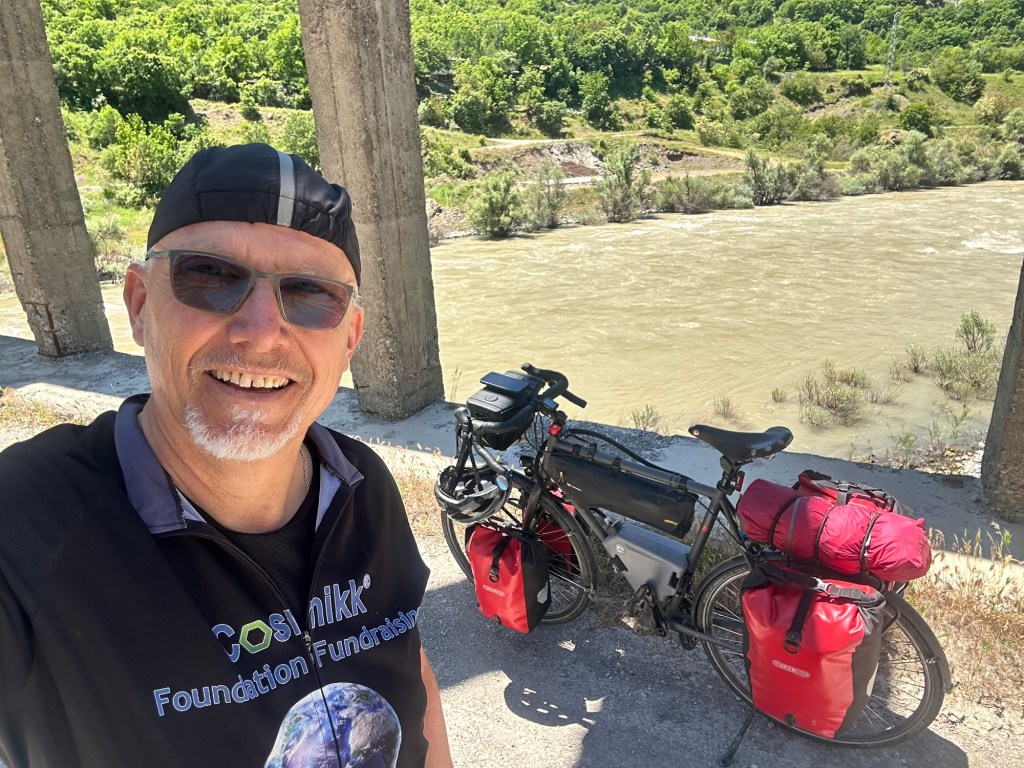
We stopped at an abandoned bridge overlooking the famous Euphrates which looked like a very normal river to us.
Claude background on the Euphrates:
The Euphrates is one of the two great rivers of Mesopotamia, alongside the Tigris, and the lands between them are often called the cradle of civilization. Along its banks in Turkey, Iraq, and Syria ancient cultures developed some of the first cities, writing systems, and laws, laying foundations that later shaped Greek, Roman, and broader western thought. Empires such as Sumer, Babylon, and Assyria rose along its waters, and their ideas about governance, astronomy, and mathematics traveled west over centuries. The river also appears in religious texts central to western tradition, including the Bible, where it is named as one of the rivers of Eden. Even today, the Euphrates remains a vital source of water for the region, and its ancient legacy still echoes in the stories and structures that shaped European culture.
After 70km we reached the next gas station. „John“ told me he had to leave. A colleague’s family would pick him up and host him, and then he would fly back to the UK for a conference. We hugged and said goodbye. It was a bit abrupt. He switched his e-bike to turbo speed and rode off to meet his ride at Mercan. I continued on my own.
Towards evening, I reached the mountains again and started climbing a narrow, picturesque valley. I had already done my shopping. I only needed water. The smart move is to wait until the last moment to fill up, since water adds eight kilograms. I was proud that I had started the climb without filling my bottles.
Then came the question: where to find a fountain. I passed an abandoned restaurant with a fountain that looked a bit dubious. It was running, so I filled my water bladders there. I felt proud that I had waited so long. A little further on, I passed two fountains made of marble, clean and perfect. I had to smile at myself. I was still not confident enough that things would work out. Another small joke from whoever is up there.
I found a camping spot surrounded on all four sides by trees, with a creek running along two sides of the meadow. The only downside was that it sat right next to the road. I decided it was good enough. I set up the tent, showered, and made dinner. I had no phone signal, so I went to bed when it got dark, around eight PM.

At night, a big thunderstorm came with heavy rain. I worried that the creek would rise and flood the meadow where my tent stood. Still, I managed to sleep for about eight hours.
Learnings of the day:
Trust is a funny thing. I like to be in control, but the consequence of being in control is that you carry too much weight when you actually want to be lighter on your feet. It is better for me to trust even more that things will work out eventually. I can still become better at that.