

Georgia surprised me. Here are eleven things I did not know before I arrived.
1. Georgia is the birthplace of wine. This is not a marketing claim. It is archaeology. Grape seeds and clay vessels found in southeastern Georgia have been dated to around 6,000 BC. That makes Georgian winemaking 8,000 years old — 3,000 years older than the invention of writing. The vessels used are called qvevri. They are egg-shaped clay pots, buried underground for fermentation. They are still in use today. And the Western words for wine — vin, vino, wine — most likely come from the Georgian word ghvino.
2. The Georgian language belongs to no other language family. It is completely alone. No living language is related to it. Around five million people speak it worldwide. It is considered one of the hardest languages to learn. And then there is the alphabet. It is called Mkhedruli. It has 33 letters. It has no upper case and no lower case. It looks like this: გამარჯობა. That means hello. Good luck.
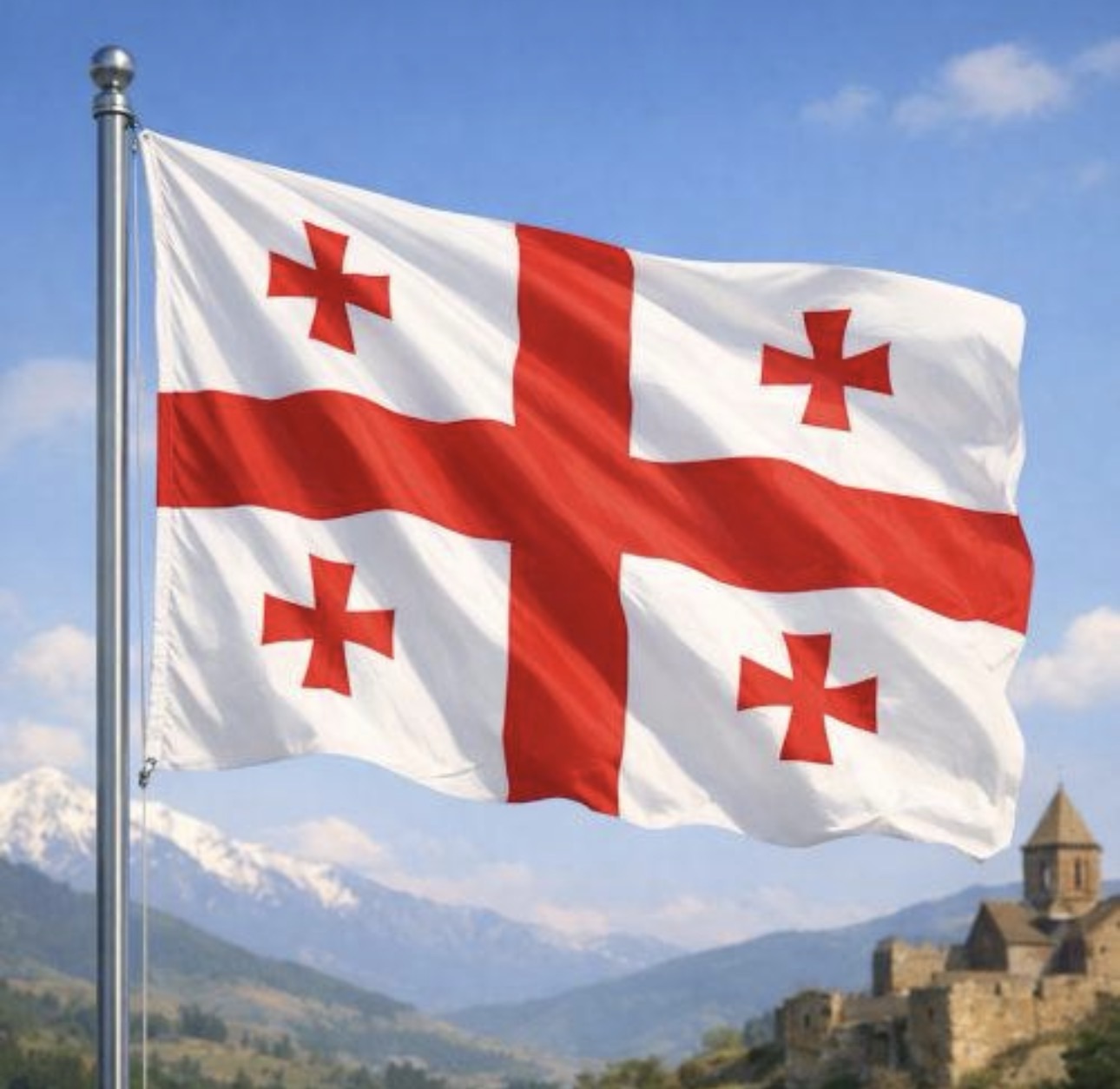
3. The flag tells a story. The Georgian flag is known as the Five-Cross Flag. A white background. One large red cross dividing the field into four quarters. A smaller red cross in each quarter. Five crosses in total. The large cross represents Christ. The four smaller ones represent the four evangelists: Matthew, Mark, Luke and John. White stands for peace. Red stands for courage. The design dates back to the 14th century. It was officially adopted again in 2004, after the end of the Soviet era.
4. The marshrutka. This is the main form of public transport in Georgia. A marshrutka is a minibus — usually old, usually full, running on a fixed route but stopping wherever someone waves. They seat around 15 passengers plus the driver. The driver treats the road as a personal racetrack. For a cyclist, a passing marshrutka is a threat. They do not slow down. They do not move over.
5. Georgian polyphonic singing. Georgians sing in multiple voices simultaneously, each part independent, the harmonies complex and ancient. UNESCO has recognised this tradition as an Intangible Cultural Heritage of Humanity. One Georgian song — Chakrulo — was included on the Voyager Golden Record sent into deep space in 1977. If there is intelligent life out there, it has already heard Georgia.
6. The Supra. The Supra is the traditional Georgian feast. It is led by a Tamada — a toastmaster — who guides the evening through a series of long, poetic toasts. It is not a dinner. It is a ritual. It can last for hours. The wine flows. The food keeps coming. Leaving early is not considered an option.
7. Hospitality as a principle. In Georgian culture, a guest is considered a gift from God. This is not a figure of speech. You feel it within the first ten minutes of arriving anywhere. People invite you in. They feed you. They pour wine. They will not hear of you leaving on an empty stomach. It is overwhelming in the best possible way. I experienced a light version of that yesterday evening.
8. Khachapuri and Khinkali. Georgia has two national dishes that deserve their own mention. Khachapuri is a cheese-filled bread. The Adjaruli version comes shaped like a boat, filled with melted cheese, butter and a raw egg cracked on top. Khinkali are large dumplings filled with spiced meat and broth. You eat them by hand. You bite a small hole in the top and drink the broth before eating the rest. If you do it wrong, everyone at the table knows.
9. Free-roaming animals. Nobody told the cows, pigs, goats and geese that roads exist. They wander freely through villages and along the roadside. They graze where they like. They cross when they feel like it. Somehow they do not get hit. Somehow they do not escape. They look completely unbothered by everything around them. For a cyclist, they add an extra element of navigation. But they are also one of the most charming things about this country.
10. The Caucasus Mountains. Georgia goes from Black Sea beach to high alpine in a very short distance. Mount Shkhara reaches 5,193 meters. The landscape is extreme. The roads follow river canyons, climb into the clouds and drop back down again. As a cyclist, you suffer. But you also get to see things that most people never see.
11. Right-hand drive cars on right-hand roads.
Georgia drives on the right. The steering wheel is supposed to be on the left. For years, Georgia imported large numbers of used cars from Japan, where they drive on the left. Japanese cars are relatively new, cheap — and built with the steering wheel on the right. New imports of right-hand drive vehicles were banned in 2018, but cars already registered before that date remain legal to drive. A driver with the wheel on the right, overtaking on a right-hand road, cannot properly see what is coming. What is coming is often me, on a bicycle.