

Distance: 37km
Elevation: 180m
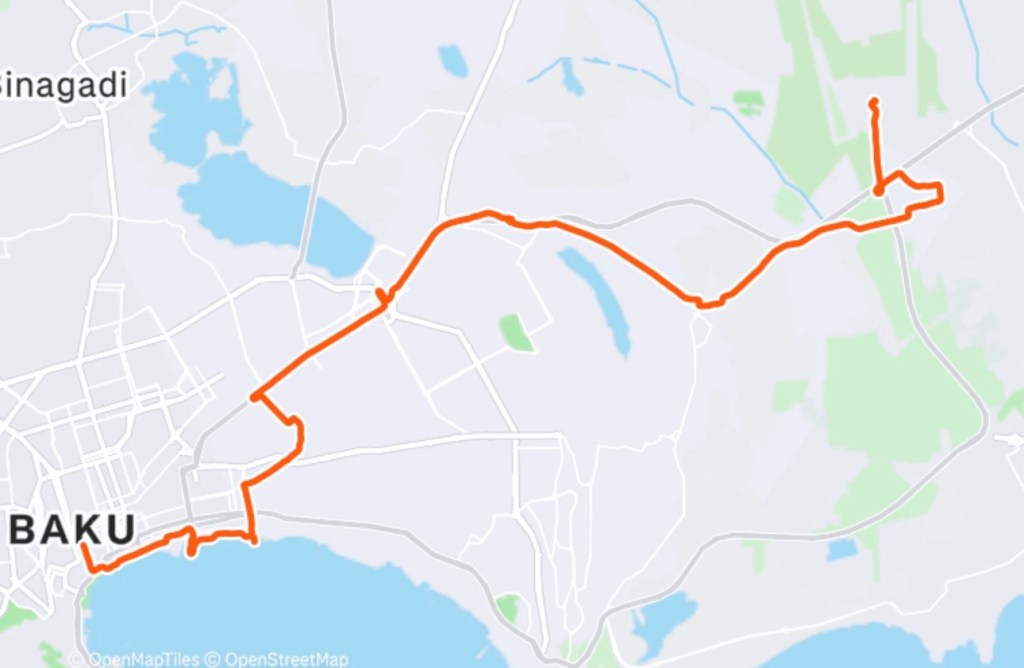
Baku: https://maps.app.goo.gl/T6neU9PyKbFhtZm27?g_st=ic
I got up early and ordered an XL taxi to the airport. I was excited. The driver turned out to be from Azerbaijan. A good coincidence. Azerbaijani is a Turkic language, and I could hear the similarities with Turkish straight away. Many words are the same.
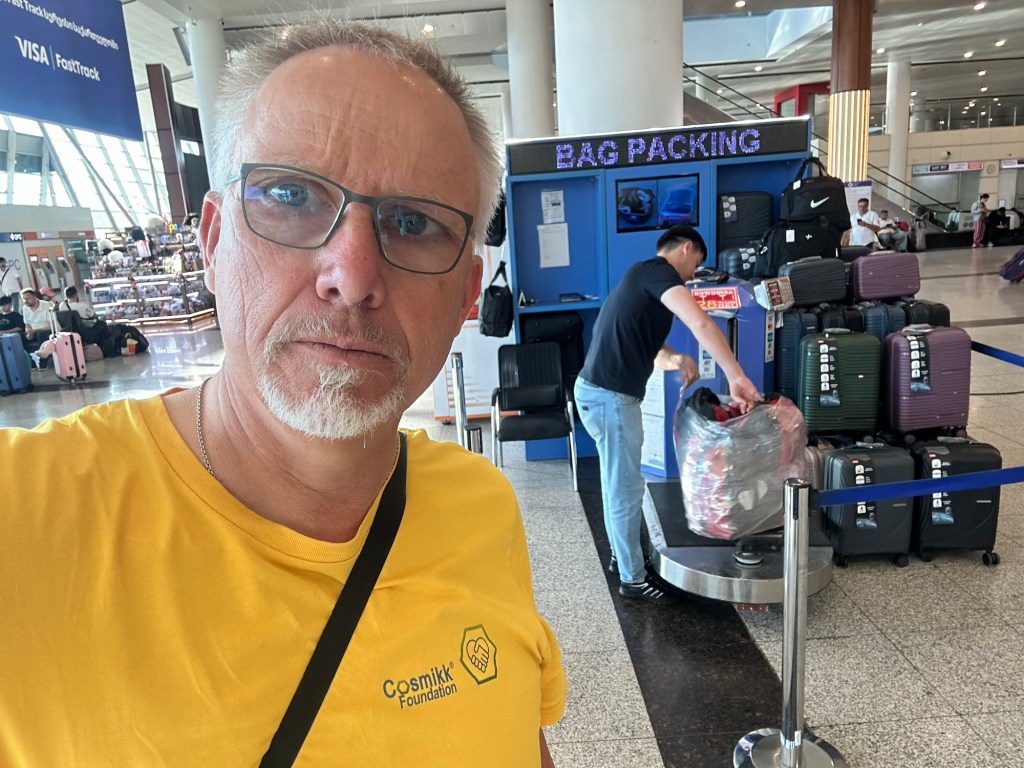
At the airport, check-in went smoothly. I got my paneers wrapped in plastic film. Rosinante’s box was checked in separately.
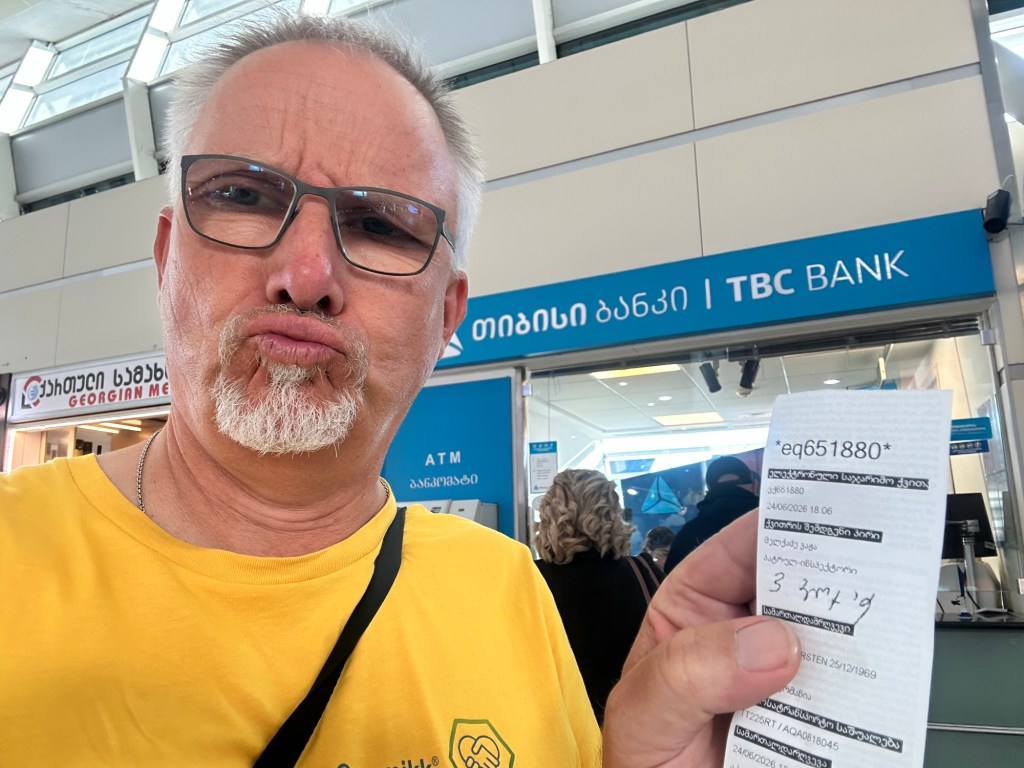
What was more challenging was paying the traffic fine from the day before. One bank sent me to another one. That one sent me to a service terminal. I did not figure out what to do there. The Georgian language did not help either. Eventually, someone gave me a web address. I paid online. That worked fine.
After security, I had breakfast and shortly after boarded the plane. The flight was one hour and ten minutes. Just enough for a short nap.
Then I arrived in Baku, Azerbaijan. Country number 25 on my tour around the world.
Claude Overview: Baku
Baku is the capital and largest city of Azerbaijan. It sits on the western shore of the Caspian Sea and is the largest city in the entire Caucasus region.
The old walled city — known as Icheri Sheher — dates back to the 12th century and is a UNESCO World Heritage Site. Its narrow streets, ancient buildings, and historic carawanserais from the Silk Road era sit right next to modern glass towers and Soviet-era blocks.
The Flame Towers are the most striking landmark. The three skyscrapers are designed to look like fire. At night, LED screens on the towers display moving flames visible from across the city. They reference Azerbaijan’s long history of fire worship.
Baku is known as the “City of Winds.” Strong winds blow year round. The name Baku itself comes from an Old Persian word meaning “God.”
In recent decades, Baku has hosted major international events: the Eurovision Song Contest in 2012, the first European Games in 2015, and the Formula 1 Azerbaijan Grand Prix since 2017. The city also hosted COP29 — the United Nations Climate Change Conference — in 2024.
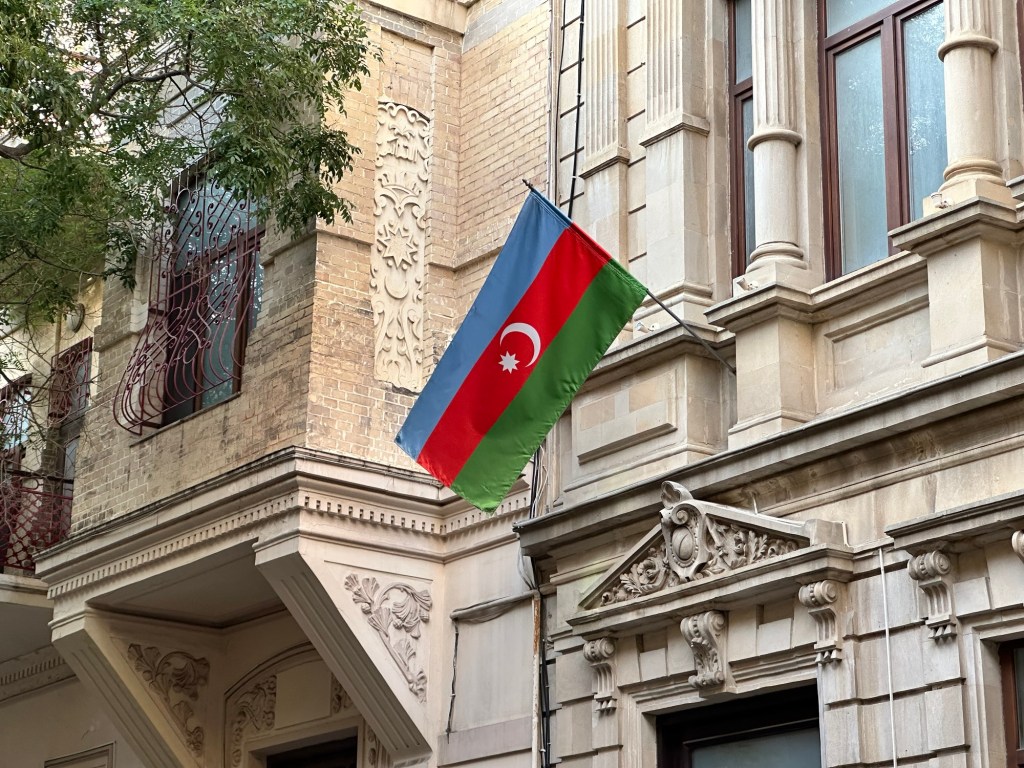
Claude Overview: Azerbaijan
Azerbaijan has a population of around 10.5 million people. Ethnic Azerbaijanis make up roughly 90 per cent of the population. The country historically hosted large Russian, Armenian, Talysh, and Jewish minorities, but wartime population transfers, emigration, and assimilation have reduced their numbers significantly. A dozen minority languages are still spoken natively, including Lezgin, Talysh, and Avar, though most of these communities are small and shrinking.
The economy is built on oil. Commercial exploitation of petroleum began in 1872, and by the start of the 20th century Baku’s oil field was the largest in the world. After the Soviet Union collapsed, a new oil and gas boom followed the construction of the Baku–Tbilisi–Ceyhan pipeline and the discovery of the Shah Deniz gas field. This enabled the ruling elite to consolidate political and economic control over the country. The wealth is visible in Baku. Less so, apparently, everywhere else in the country.
Around 96 per cent of the population identify as Muslim — roughly 65% Shia and 35% Sunni. Azerbaijan has no official state religion. The role of Islam in everyday life remains relatively small. For many Azerbaijanis, the association with Islam is more a matter of cultural identity than of religious practice. Azerbaijan is widely considered the most secular Muslim-majority country in the world.
There are also small but long-established Jewish communities — Mountain Jews, Ashkenazi Jews, and Georgian Jews — totalling around 16,000 people. The Red Town of Quba has been home to Jews since the 13th century and is believed to be the only all-Jewish town outside of Israel.
President Ilham Aliyev — who took over from his father in 2003 — won a fifth term in February 2024 with more than 92% of the vote. International observers noted a lack of genuine competition and restrictions on media and civil society monitoring. In 2025, there were 375 political prisoners in Azerbaijan. All foreign broadcasts are banned. The country ranks among the most censored in the world. In August 2025, President Aliyev and Armenian Prime Minister Pashinyan signed a joint declaration at the White House, committing to a peace deal that would end nearly four decades of conflict between the two countries.
It is a complicated place. But so far Baku feels friendly, modern and cosmopolitan to me.
Immigration was quick and friendly. No questions were asked regarding my recent trip to Armenia.
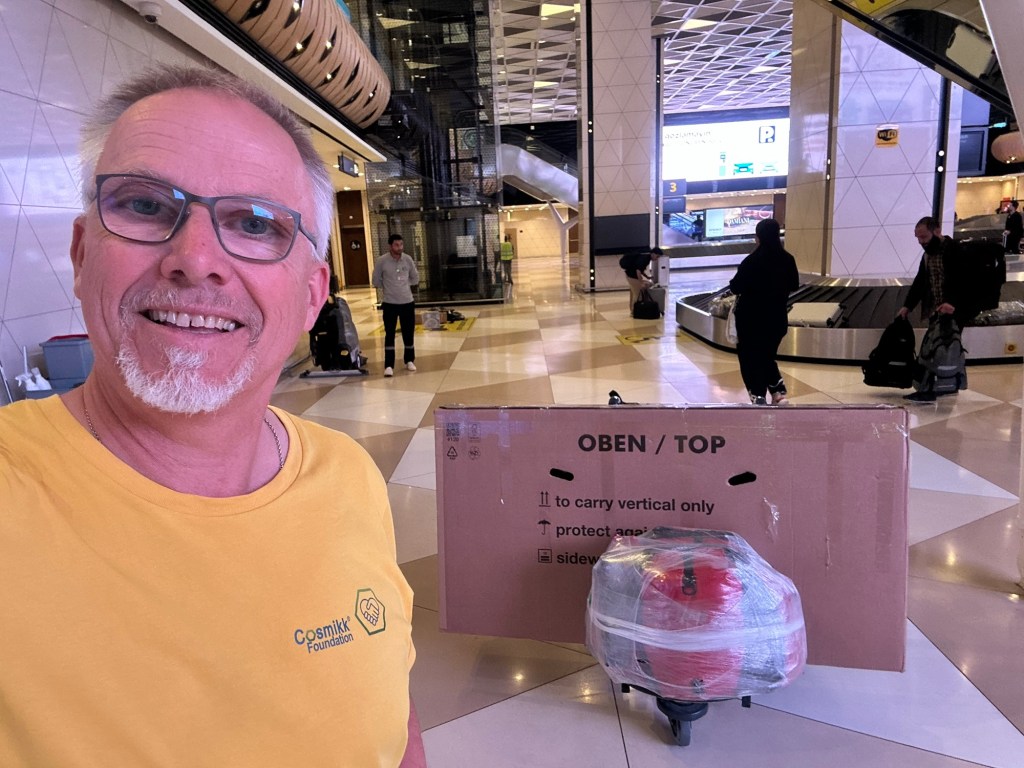
Within 15 minutes of arrival, my bags and Rosinante had arrived. No drama. No long wait. No missing luggage. Not what I am used to from Frankfurt and other big airports.
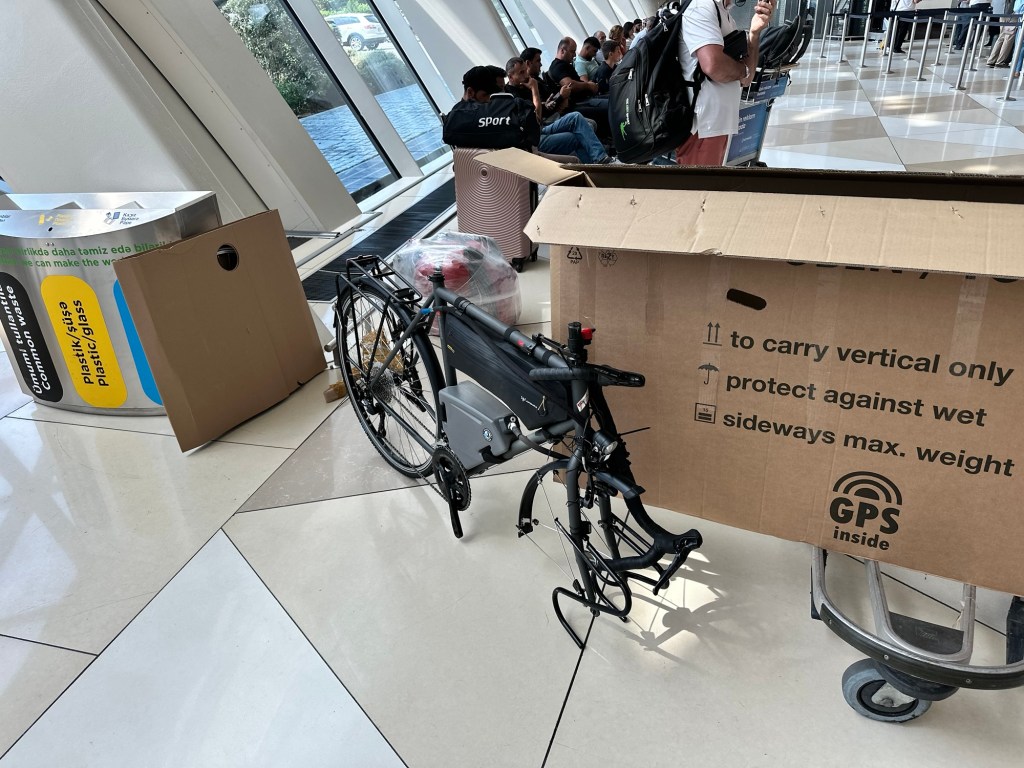
I found a quiet corner and assembled Rosinante. I took my time to avoid mistakes. One hour later, Rosinante was ready to ride again.
I changed into my cycling clothes and set off for the guesthouse I had booked in the city centre. Komoot was not working for me in this part of the world. So I asked Google Maps to avoid motorways and find me a route.
The cycling was easy. Very flat. A slight tailwind. Car drivers were calm and considerate. I rode mostly on back roads. At one point I found myself on a 14-lane highway. Even there I did not feel threatened. It was fine.
To cut a few kilometres, I lifted Rosinante over a pedestrian bridge crossing a highway. Immediately, a young man appeared and helped me push her up the slope. A little further on, another young man handed me a bottle of cold water as I rode past. First impressions: kind people.
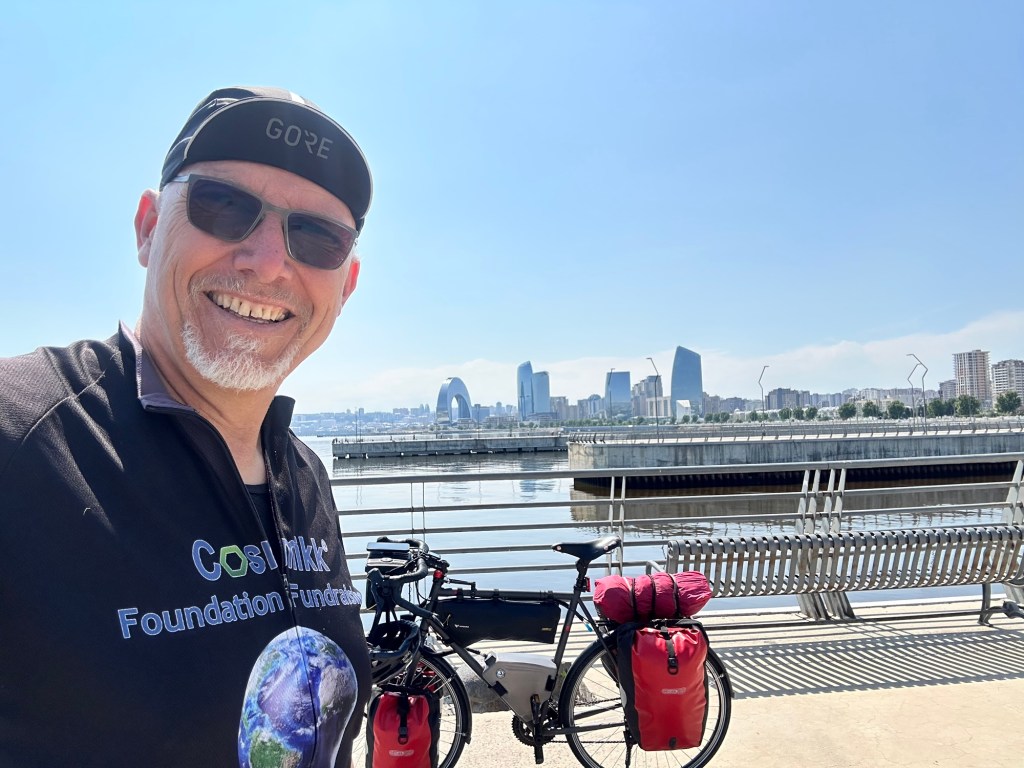
As I got closer to the centre, I detoured to the seafront. Wide pedestrian paths. Cycling lanes. A nice view of the Baku skyline. About 30 degrees with a light breeze. Very pleasant.
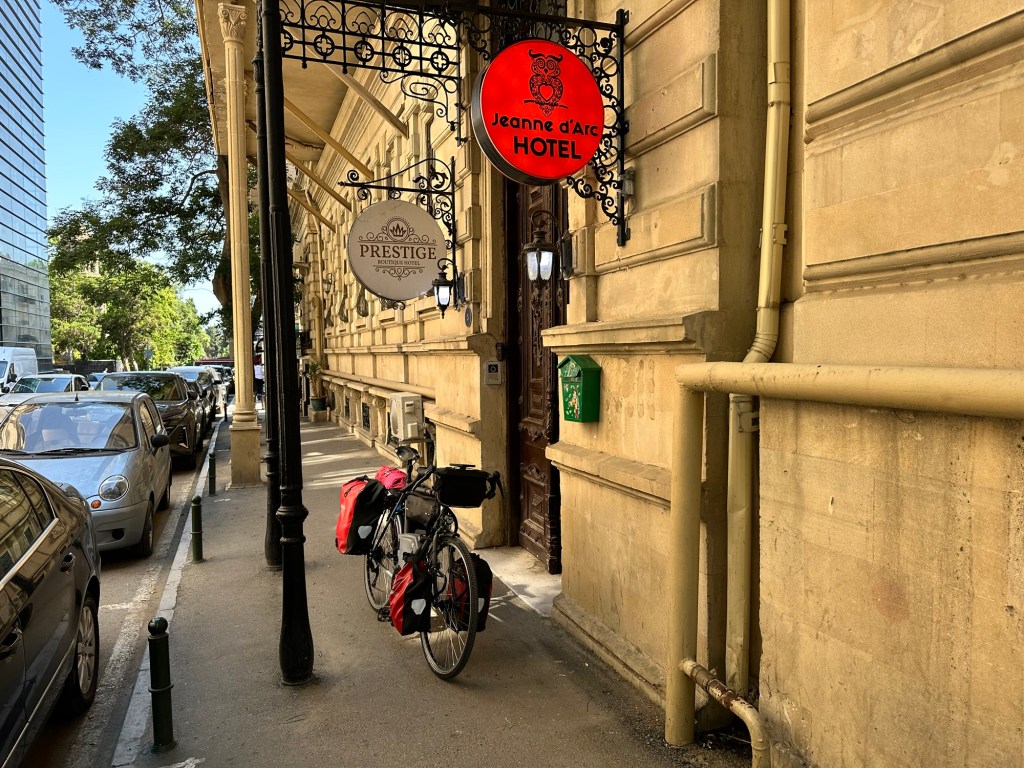
By 4pm I arrived at the guesthouse and checked in. The guesthouse is on the first floor. I had to carry Rosinante up the stairs. The host came out and helped with the bags.

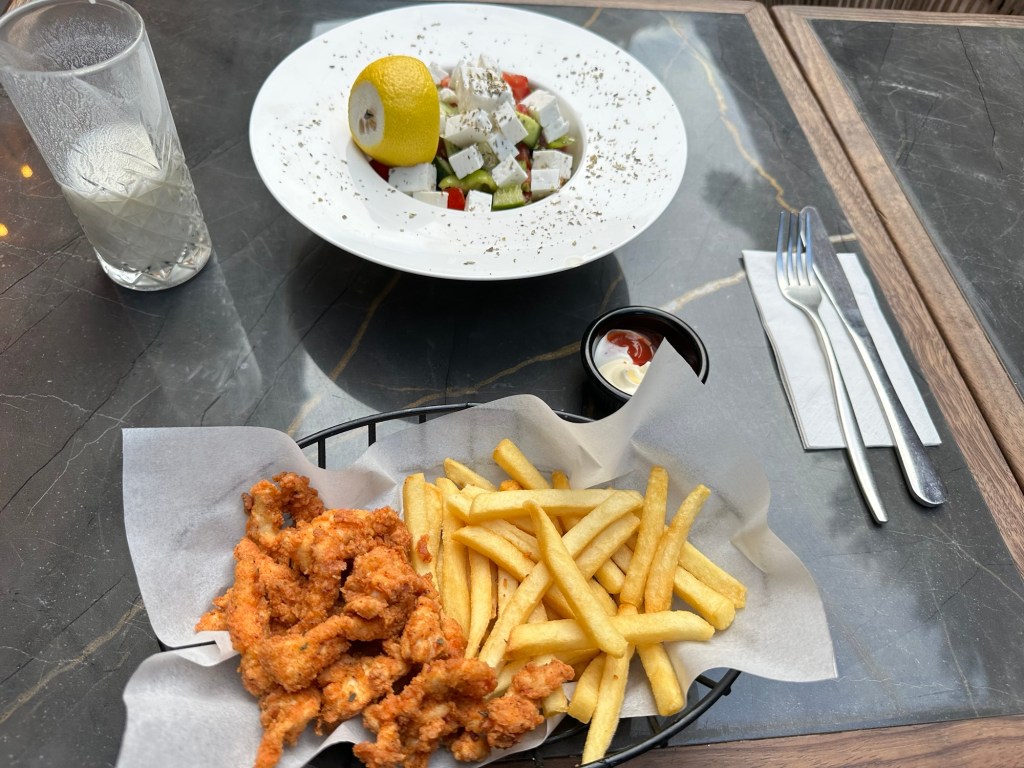
After settling in, I went out for groceries. Then, early in the evening, I went for a simple dinner. Comfort food. I still recovered from the dinner in Yerevan the other night.
I ended the evening at a local Irish pub. One pint of Guinness.I was tired from the excitement of the day.
Then back to the guesthouse. I was in bed by 9 pm.
Learnings of the day:
Before I arrived in Azerbaijan, I had a picture in my head.
And then you arrive. Friendly immigration, considerate drivers, a young man helps you push your bike up a bridge without being asked. Another hands you a cold bottle of water.
Mark Twain once wrote “Travel is fatal to prejudice, bigotry and narrow-mindedness.”
You can read every fact there is about a country. And you will still arrive with a simplified picture. It takes being there — the heat, the sounds, the face of the person handing you water — to make it real and complicated and human.
That is what traveling does. It does not replace the facts. It sits next to them, and refuses to let them be the whole story.