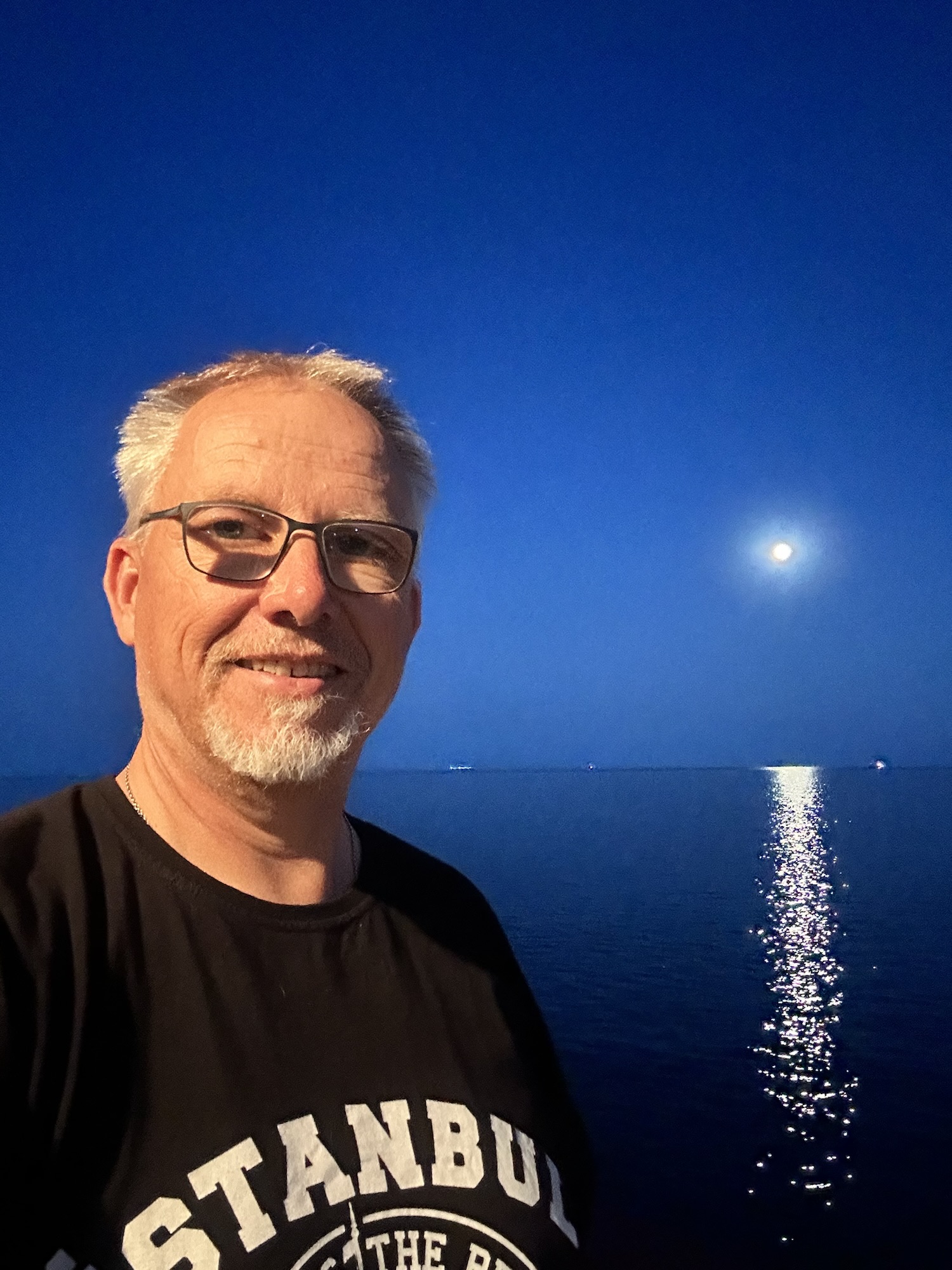


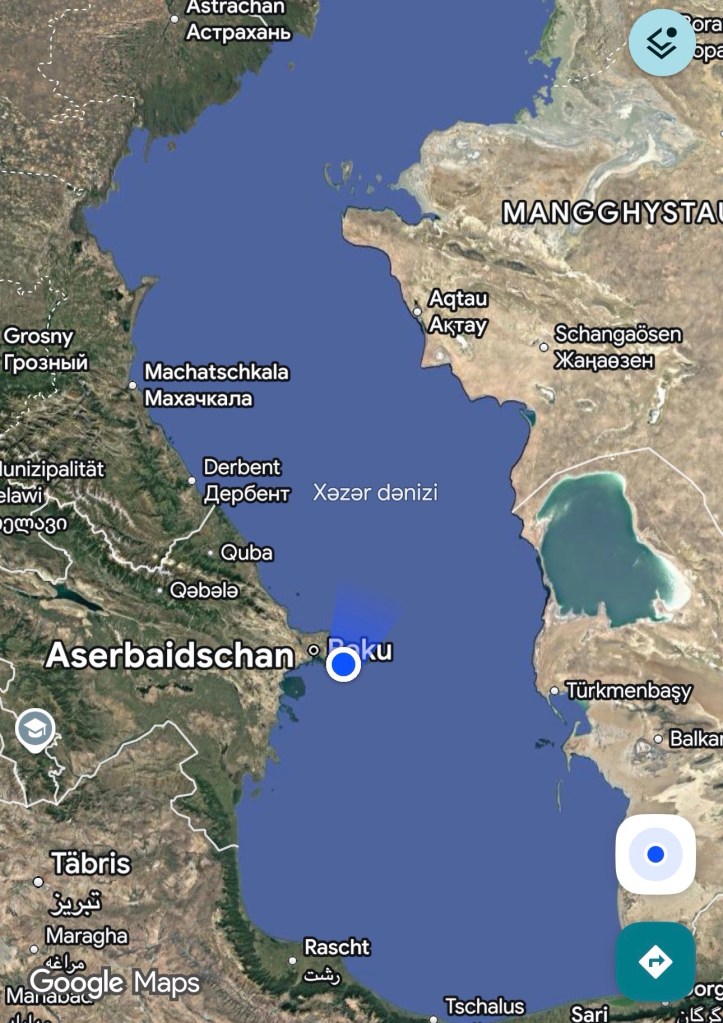
Distance: 70km (by ship)
Elevation: 0 m
Around 7:30 in the morning, a firm knock at the cabin door announced breakfast. We were still docked in Port Alat.
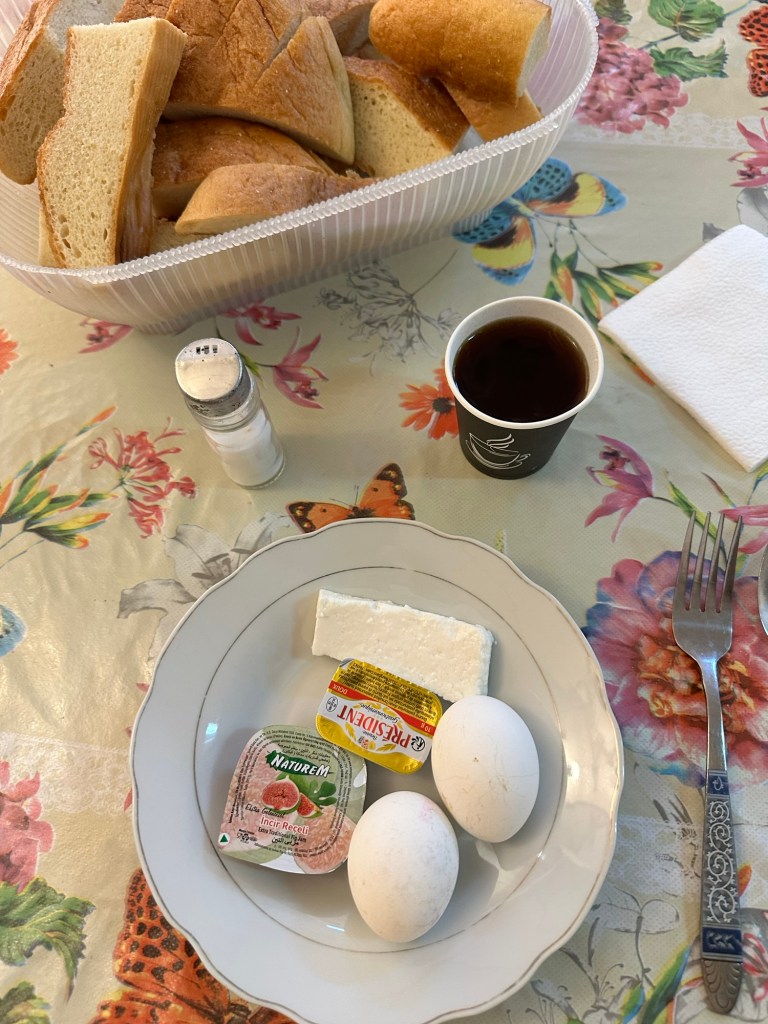
Each passenger received a plate with two boiled eggs, a piece of goat cheese, butter, and fig marmalade. On every table there was a large box of sliced bread. There was also chai. It was simple but quite good.
Not much was said in the dining room. Most people did not know each other and did not share a common language. The truck drivers came from Georgia, Azerbaijan, Ukraine, Kazakhstan, Uzbekistan, and other places — the ship’s chef had told me this the evening before. One of them, Olchan, spoke a little English. He was from Baku, 44 years old, and had two boys aged one and six. He had been working on this ship for seventeen years.

The Mercury-1 was over forty years old. Rust and a vintage look were visible everywhere. But she was still working.
Around 10am we were supposed to depart. At 9:45, my cabin door opened. One of the reception ladies and the crew member who had taken Rosinante for a test drive the evening before were asking me to come with them quickly and to bring my passport and visa. They looked concerned.
They rushed me off the ship and into the passport control building, where two officers were already waiting. They signalled me to hurry. It emerged that they had forgotten to stamp my passport when I exited Azerbaijan the day before. They were now in trouble because of this. The higher-ranking officer was visibly stressed, trying to start up the computer. The other officer wanted to have a conversation about my trip to Armenia. Why had I gone there? Which country did I prefer? Since the two countries had been in conflict for decades, I answered as diplomatically as I could.
Claude Overview: The Armenia-Azerbaijan Conflict
The conflict between Armenia and Azerbaijan centres on Nagorno-Karabakh, a mountainous region in the South Caucasus. It is an ethnic and territorial dispute over a region that was inhabited mostly by ethnic Armenians until their expulsion in 2023, and seven surrounding districts that were inhabited mostly by Azerbaijanis until their expulsion during the 1990s. Wikipedia
In 1923, the Soviet Union established the Nagorno-Karabakh Autonomous Oblast — home to a population that was 95 percent ethnically Armenian — within the Azerbaijan Soviet Socialist Republic.
As the Soviet Union began to collapse in the late 1980s, the Armenian population of Nagorno-Karabakh declared their intention to secede from Azerbaijan and unite with Armenia. This eventually escalated into a full-scale war from 1991 to 1994, resulting in significant casualties on both sides and the displacement of hundreds of thousands of people.
The first Karabakh war resulted in roughly thirty thousand casualties and created hundreds of thousands of refugees. By 1993, Armenia had gained control of Nagorno-Karabakh and occupied around 20 percent of Azerbaijan’s geographic area. In 1994, Russia brokered a ceasefire, leaving Nagorno-Karabakh de facto independent but still heavily reliant on Armenia.
In late 2020, a large-scale Second Nagorno-Karabakh War resulted in thousands of casualties and a significant Azerbaijani victory. Azerbaijan captured one-third of Nagorno-Karabakh and regained control over the surrounding territories. Then in September 2023, Azerbaijan launched a military offensive, expelled the entire population, dissolved the government of Nagorno-Karabakh, and incorporated the territory into Azerbaijan.
In August 2025, Azerbaijan and Armenia signed a US-brokered peace agreement in Washington, aiming to end the conflict, reopen transport routes, and normalise relations.
The wounds on both sides run deep. The region carries more than a century of displacement, war, and unresolved grief.
After a bit of back and forth, I finally received my exit stamp and was asked to return to the ship quickly. The situation was bizarre and also a little funny.
On the way back, I noticed that the cargo bay had filled up during the night. Trucks, trailers, and freight wagons, each secured with thick ropes. Shortly after I reboarded, the ship left port.
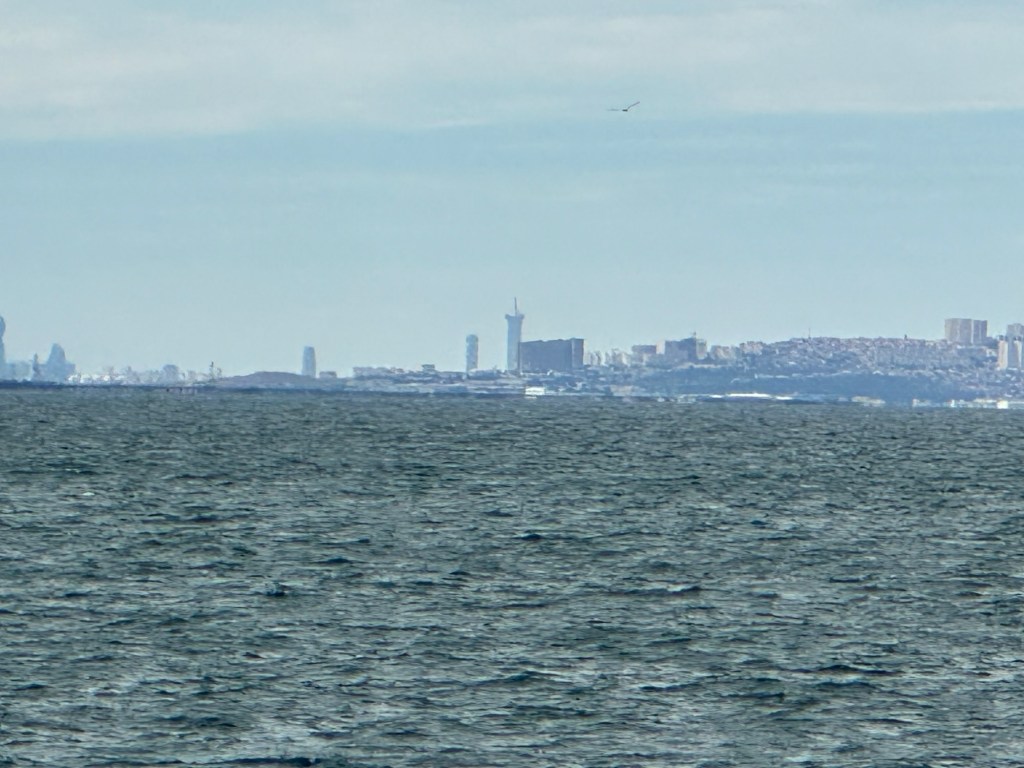
We were finally sailing north, towards Kasachstan.
Around noon, the engines stopped and the anchor dropped. We were waiting again, apparently due to bad weather further north. Fortunately we were still close enough to the coast to have some mobile signal. I got some office work done. I had no flights booked for my return journey yet, but I was working through various options. I really wanted to get home.
Lunch and dinner came and went as the main highlights of the day. Everyone was on their phones. I worked in my cabin. Every now and then I drifted off to sleep.

In the evening I called Carolin to show her the full moon over the Caspian Sea. It was beautiful.

Around 9pm the engines started again. I watched the flickering skyline of Baku for a while. In the distance, the Flame Towers — a landmark of the city — were lit up in their signature style. When the ship finally began to move, I went to bed and fell asleep quickly.
Learnings of the day:
When I am disconnected from information and feel out of control, two things matter.
The first is reaching out to others. A phone call. A short exchange. Something that re-establishes a human connection and gives me a little more context about what is happening.
The second is focusing on what I can still do. Making a list. Working through something concrete. Writing about something that means something to me. Without that, the alternative arrives quickly: a numb, helpless feeling that slides towards low mood. What surprises me every time is how fast that shift happens when I feel powerless. A missing network signal is enough to amplify it.
It is strange to think there was a time before mobile phones and the internet.