

Distance: 101 km
Elevation: 200m
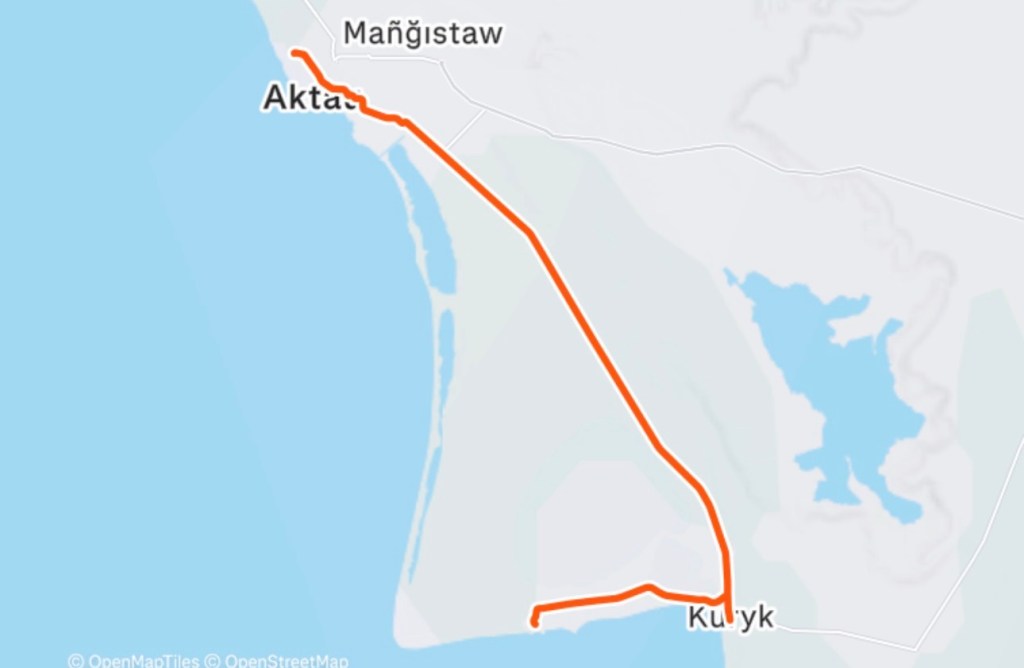
Aqtau: https://maps.app.goo.gl/7SyaqnQnWJEdpiqE8?g_st=ic
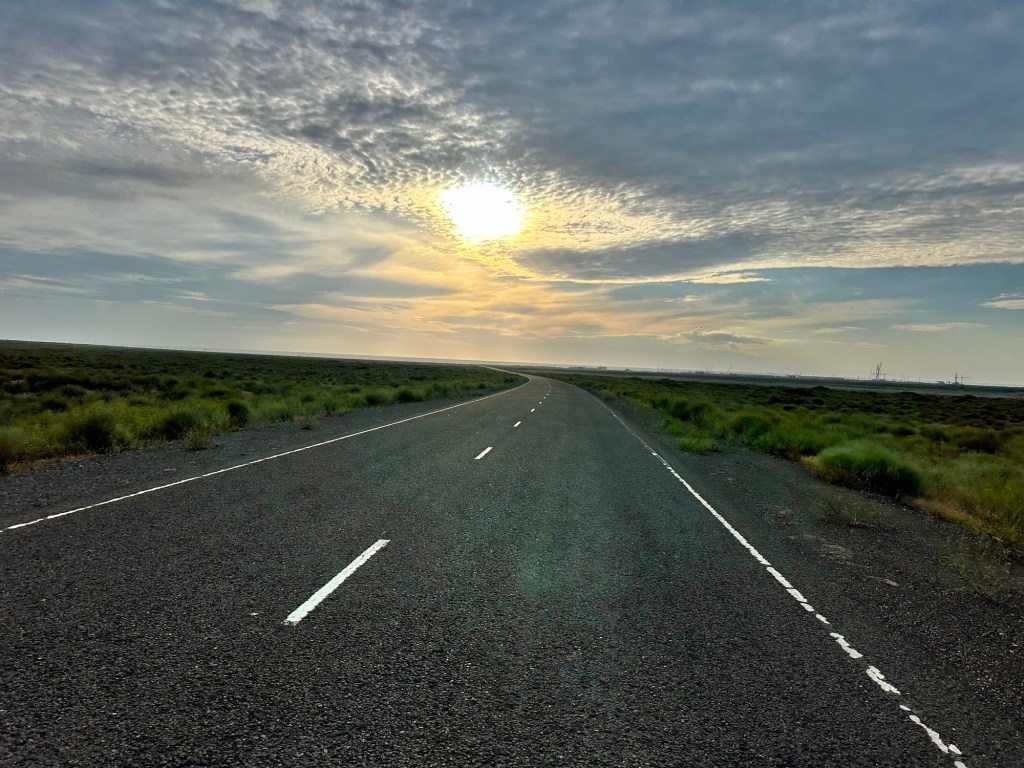
I woke up early after a good night sleep. I was on the road by 7am. The first twenty kilometers took me to Kuryk. I had a beautiful tailwind.
I noticed I was low on water. So I went into the town to find a shop. No shop was open yet and there were also no fountains.
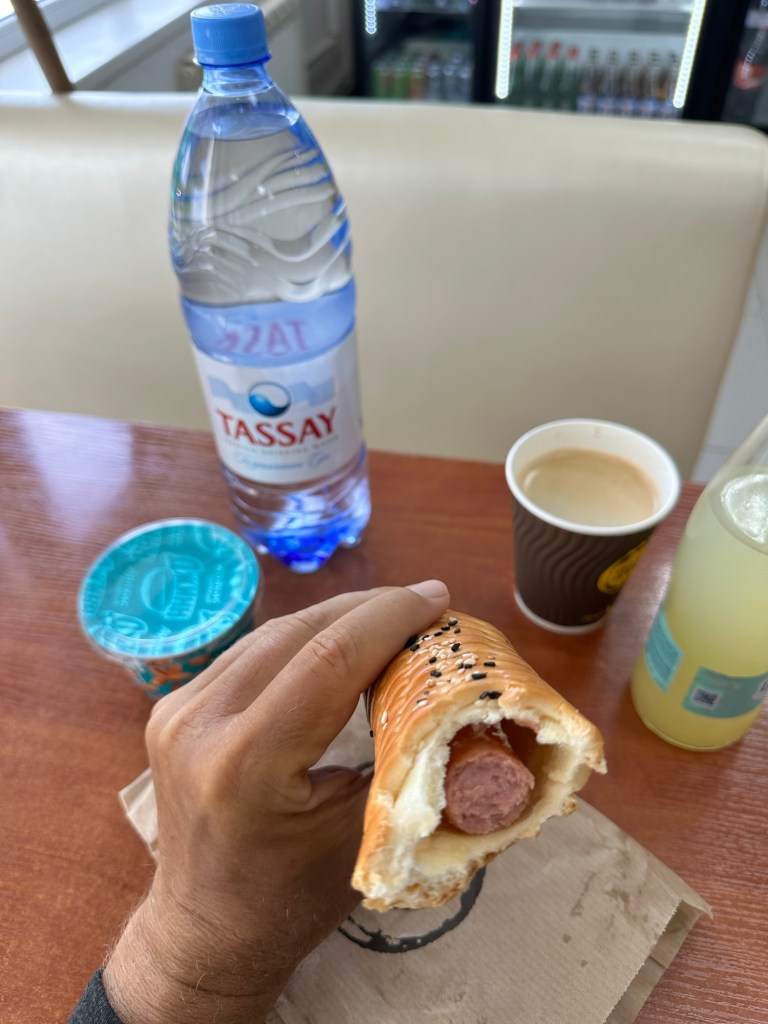
So I turned North toward Aktau. Luckily, I found a gas station on the way. I filled up my water there and had breakfast.
The road to Aktau was a straight line through the steppe. It was eighty kilometers long. There were no trees. Only small bushes. The headwind was strong and relentless.
I used my usual method. I focus on one chunk of five kilometers at a time. I take a short break. Then I do the next chunk. This makes long distances easier. It is like the stoic method of splitting a big challenge into small parts. You focus on one part at a time. Over time, you can manage things that once seemed impossible.
I saw turtles and wild horses next to the road. I also saw many camels. At one point, I was so focused on fighting the wind that I had my head down. I looked up and saw a camel standing close, staring at me. It was a strange sight. It made me happy.

Traffic was light. The sun was strong in the middle of the day.
After seventy-five kilometers, it got really hard. I was running low on water again. A gas station was marked at around kilometer ninety. I struggled to reach it. Before I got there, I noticed a new problem. My rear wheel was falling apart. Several spokes had come loose. The wheel was wobbling. It rubbed against the brake pads and even the frame. This added extra resistance.
So I was fighting two things at once: the wind, and a broken wheel. Shortly before Aktau, I was ready to give up. I tried to order a Yandex taxi, but no driver accepted the job. So I kept going. I loosened my brakes so the wheel would rub less. After ninety kilometers, I entered Aktau. I reached the gas station, just as planned. That helped a lot.
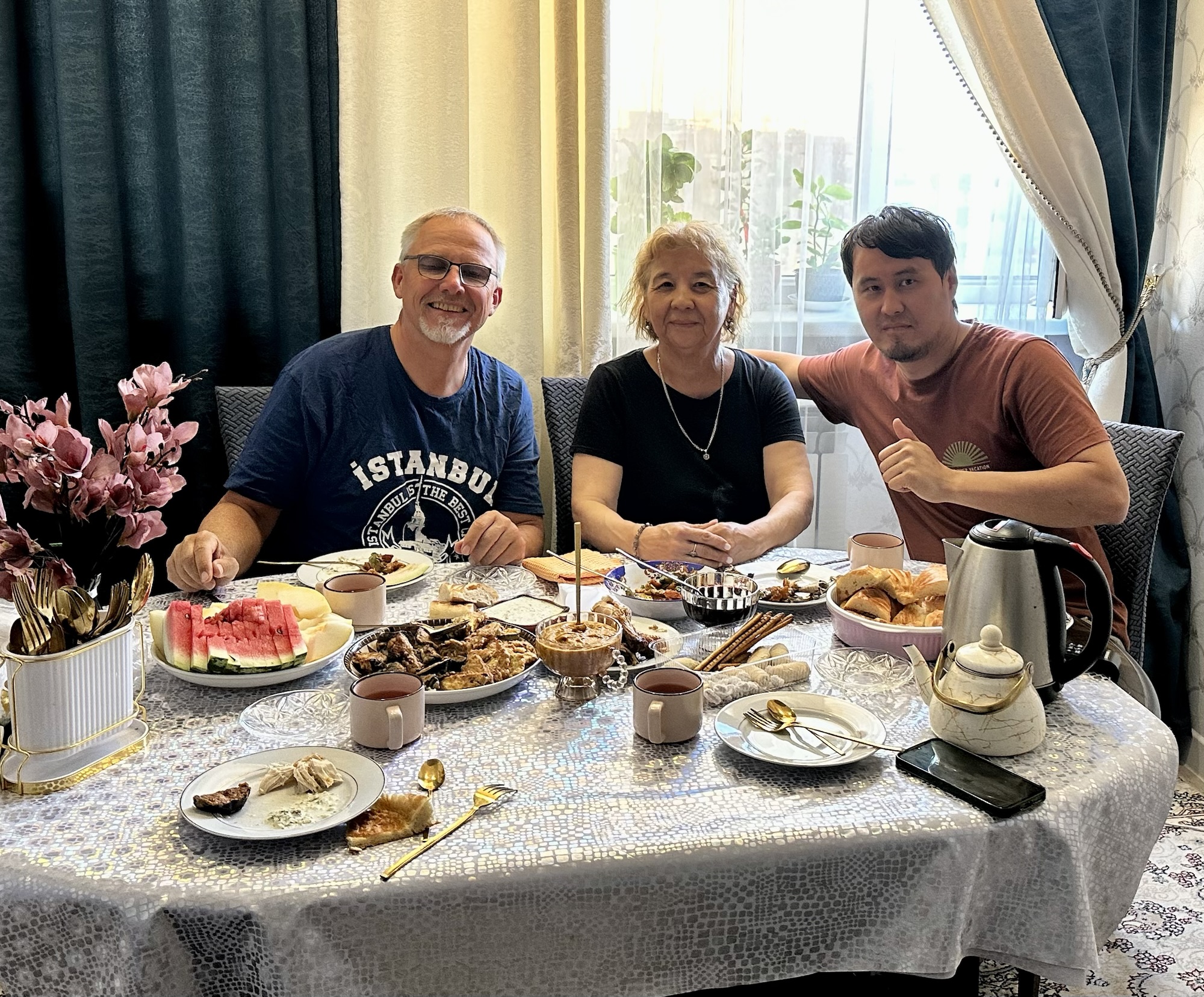
I managed the last ten kilometers to my Warmshowers host, Rustem. I arrived at his door with almost no energy left. He was busy with something else, so I waited in a coffee shop nearby. When he came, he invited me into his apartment. He lives there with his mother and his younger brother.
As his mother was preparing dinner, I took a shower and changed. Then we talked about life in Kazakhstan. We talked about work, politics, the economy, and travel. I asked Rustem why he hosts cyclists, since he is not an avid cyclist himself. For him, it is a way to bring the world into his home. It lets him practice English and meet people from different countries. His mother had learned some German in school. She tried out a few German words on me during the evening.
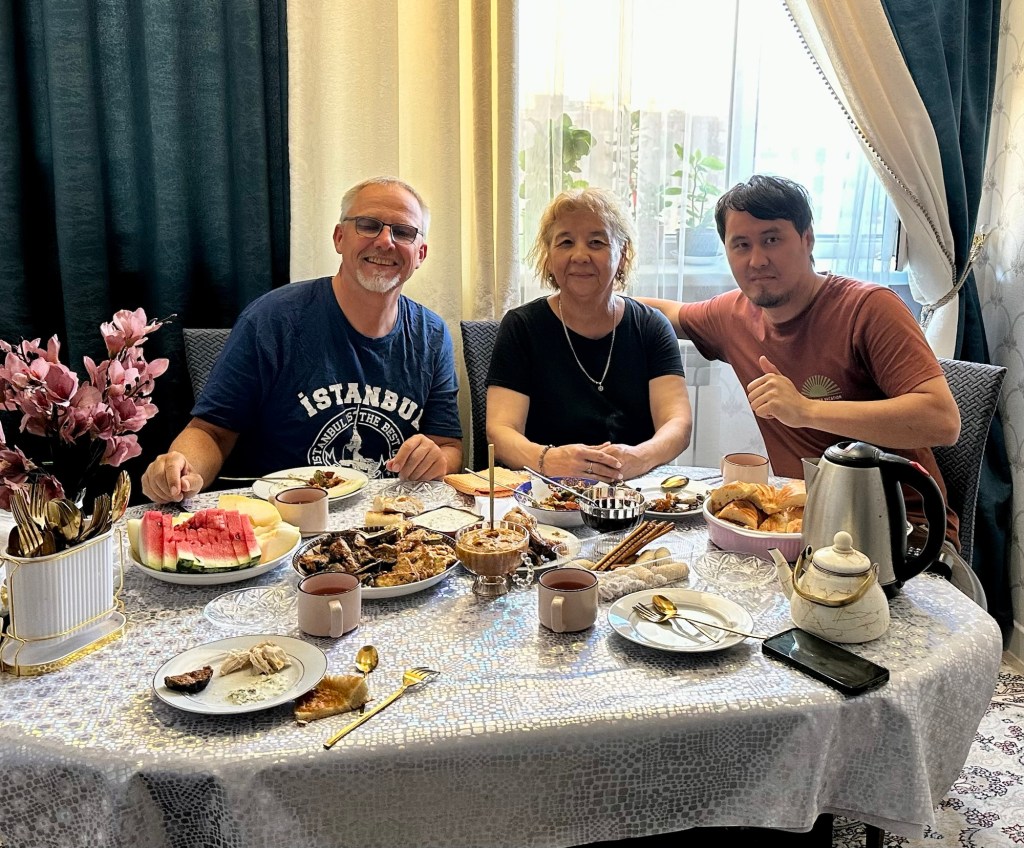
Dinner was the best meal of the whole trip so far. It helped that Rustem’s mother works as a chef on an oil field. Rustem also works on a more remote oil field as an electrician. 14 days on, 14 days off. He is also a skilled mechanic. Right now he was on vacation. He is 34 years old and speaks pretty good English. We had a nice evening together.
Before the evening ended, we solved a practical problem. Rustem agreed to store Rosinante in his apartment until next year June when I will continue my tour across the Pamir Highway, one of the highest cyclable roads in the world.. This was a big relief and a sign of great hospitality.
Around 10pm, I went to bed. I had an early flight at 4am the next day, so I needed to be up after a couple of hours.
Claude Overview: Kazakhstan
Kazakhstan is the world’s ninth-largest country by land area. It is also the largest landlocked country in the world. It borders Russia to the north and west, China to the east, Kyrgyzstan and Uzbekistan to the south, and Turkmenistan to the southwest. It has a coastline along the Caspian Sea. The country covers three time zones. Much of the land is flat steppe, but the south and east have mountains.
The climate is sharply continental. Summers are hot and winters are cold, and precipitation is generally low. In some parts, winter temperatures can drop below minus 40 degrees Celsius, while summer heat can pass 40 degrees. This explains the wind and the empty, dry landscape I rode through.
Most people in Kazakhstan are ethnic Kazakh. Russians still make up a sizable minority, close to eighteen percent of the population. Smaller groups include Uzbeks, Ukrainians, Uighurs, Tatars, and Germans. Kazakh is a Turkic language. Russian is widely used as the language of everyday communication between different groups.
Kazakhstan is officially secular, but it is a Muslim-majority country with a sizeable Christian community. In practice, this means mosques and Orthodox churches often stand close to each other, and religion is treated as a personal matter rather than a state one.
Horses and camels are not unusual sights along the road. Kazakhs were traditionally pastoral nomads. They herded horses, sheep, and camels on the grasslands in summer and moved to more sheltered pastures in winter. Even today, animals still roam freely in the open steppe, far from any fence.
Kazakhstan is rich in natural resources. It has large reserves of oil, coal, and metals, including some of the world’s biggest oil fields. This is part of why so many people I meet along the road, like Rustem, work in the oil industry.