

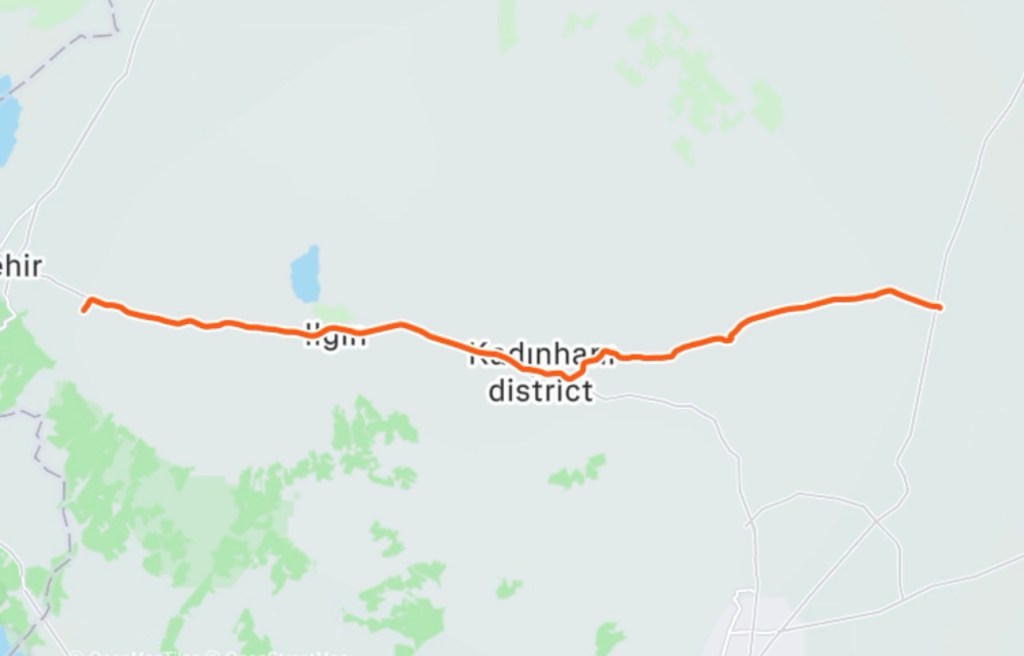
Distance: 118km
Elevation: 579m
I got up at sunrise and enjoyed the morning sun in the middle of open nature. Breakfast came with strong French press coffee. Nothing against Turkish tea, but nothing beats that coffee. I carry the French press with me wherever I go.
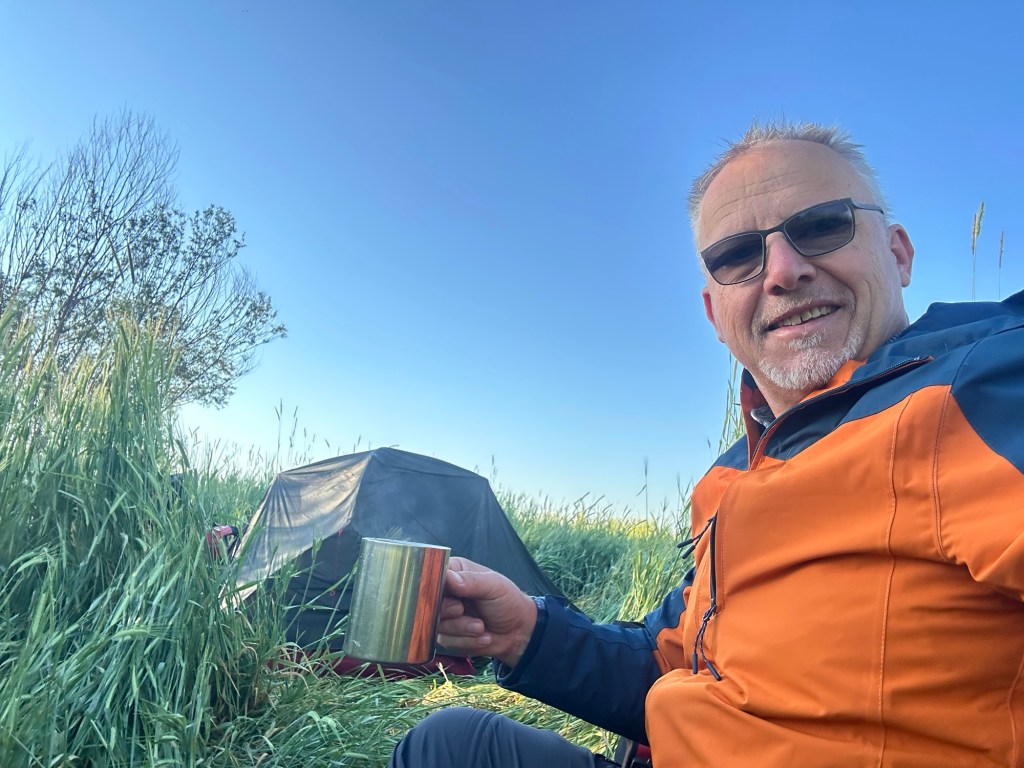
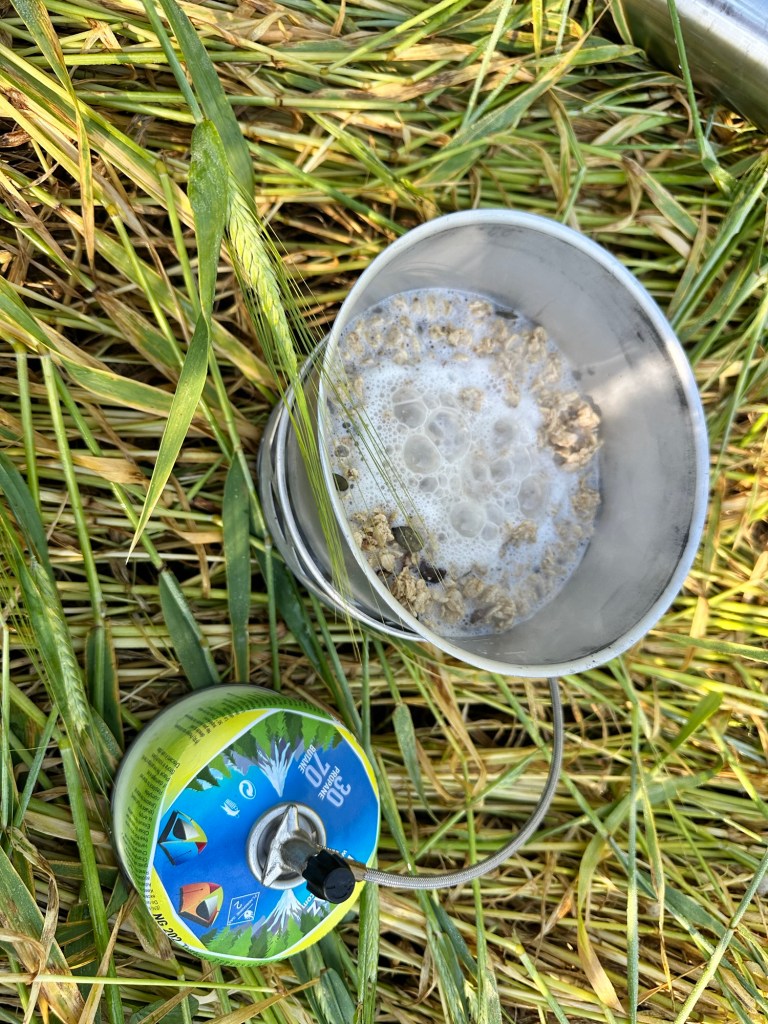
The tent was soaking wet, everything was, so I waited and let the sun do its work before packing up. I wrote the blog, prepared my granola, dressed, packed, took all my rubbish with me as always, and hit the road at half past nine.
Before packing up, I traded messages with Beate, a friend of ours who is about to travel to Baku in Azerbaijan. My route takes me through Georgia and I have been looking into the train connection from Tbilisi to Baku. It is a route that carries a bit of history. The direct rail link between Georgia and Azerbaijan as well as the border entry via land was suspended after COVID and only the overnight train connection resumed relatively recently, which makes it something of a small event in the region just to have it running again. Supposedly tickets sell out quickly. The problem is the booking system. It exists, but it does not really work. So I asked our friend, who will be on the ground in Baku, whether she might be able to get to a ticket window and sort it out in person. She was open to trying. Fingers crossed. If it works, I have my onward connection from Tbilisi sorted. If it does not, I will figure something out, but this would be the cleaner solution.
The first sixty kilometers were on highways which was helpful to cover some distance. At every gas station I stopped, both to cool off and to take in enough liquid other than water. I had developed a sore throat during the night, and the frequent breaks helped. It did get better as the day went on. Cycling on a highway is not particularly inspiring, but the rolling hills are gentle, the shoulder is wide, and the truck drivers and passing cars were generous with friendly honks.
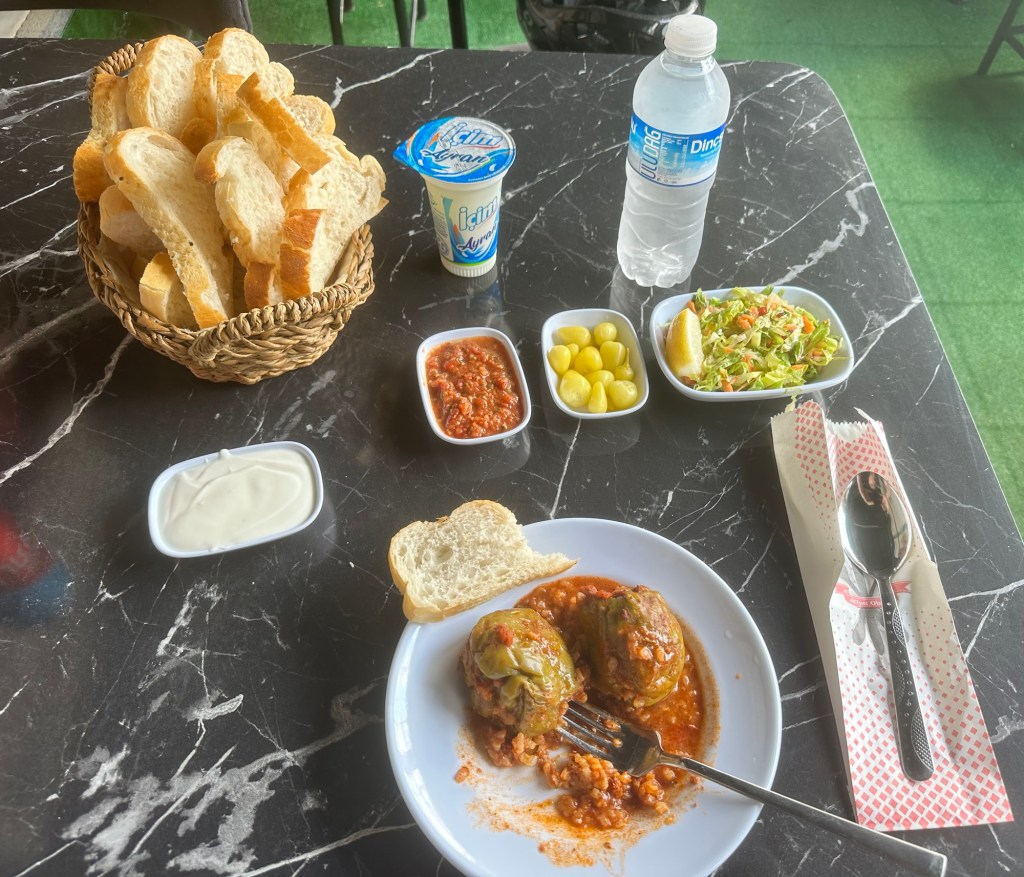
Around two in the afternoon I arrived in Kadınhanı and had lunch. My goal had been to avoid the familiar Dürum or Döner, nothing that I could just as well eat at home in Germany. I found a stuffed pepper. I have no idea what the filling was, but it came with yogurt, a hot sauce, small peppers, and bread, and it was genuinely delicious. While I was eating, a thunderstorm came up directly overhead. It rained. The timing was perfect. I sat it out, took my time, and after about two hours I was back on the road.
I had learned that a long midday break makes sense when you plan to stay out. Arriving at your spot before seven in the evening draws too much attention. The break also refilled the energy reserves for the evening shift.
The last sixty kilometers were on back roads, which were a different experience altogether. Something has been shifting in the landscape. The dominant color green is slowly giving way to brown. It is getting drier. Fewer fountains. Everything is a bit more basic. The people here are farmers. You can see it in how the land looks and how the day runs.
In a small village that looked like it had nothing to offer, and where Google Maps agreed, I made a small detour anyway and found a shop. It did not look like a shop. It was a door in a wall. I went in, bought something cold to drink and icecream, and shortly after, a man on the street asked if I needed any help. He introduced himself as the imam of the village. He was around thirty or thirty-five. He was also, it turned out, a Wing Tsun instructor. You could not make these stories up.
While we were talking, an older man joined us and addressed me in German. Back in his working years he had been a truck driver, and he still remembered enough to get by, especially for directions. He knew words like „immer geradeaus“. Always straight ahead. That made me smile.
I asked the imam whether I could attend one of the prayer services. He declined with a friendly smile. Prayer services in Islam are generally not open to non-Muslims. The mosque is a sacred space reserved for those of the faith, and attendance at the salah, the five daily prayers, is understood as an act of worship rather than a public event. Inviting non-believers in would not align with that purpose. I respect that completely. It would have been a reason to stay an extra day, to wait for the next call to prayer and see what that life looks like from the inside. But it was not my place.
To prepare for the evening I stocked up an extra 4l of water.

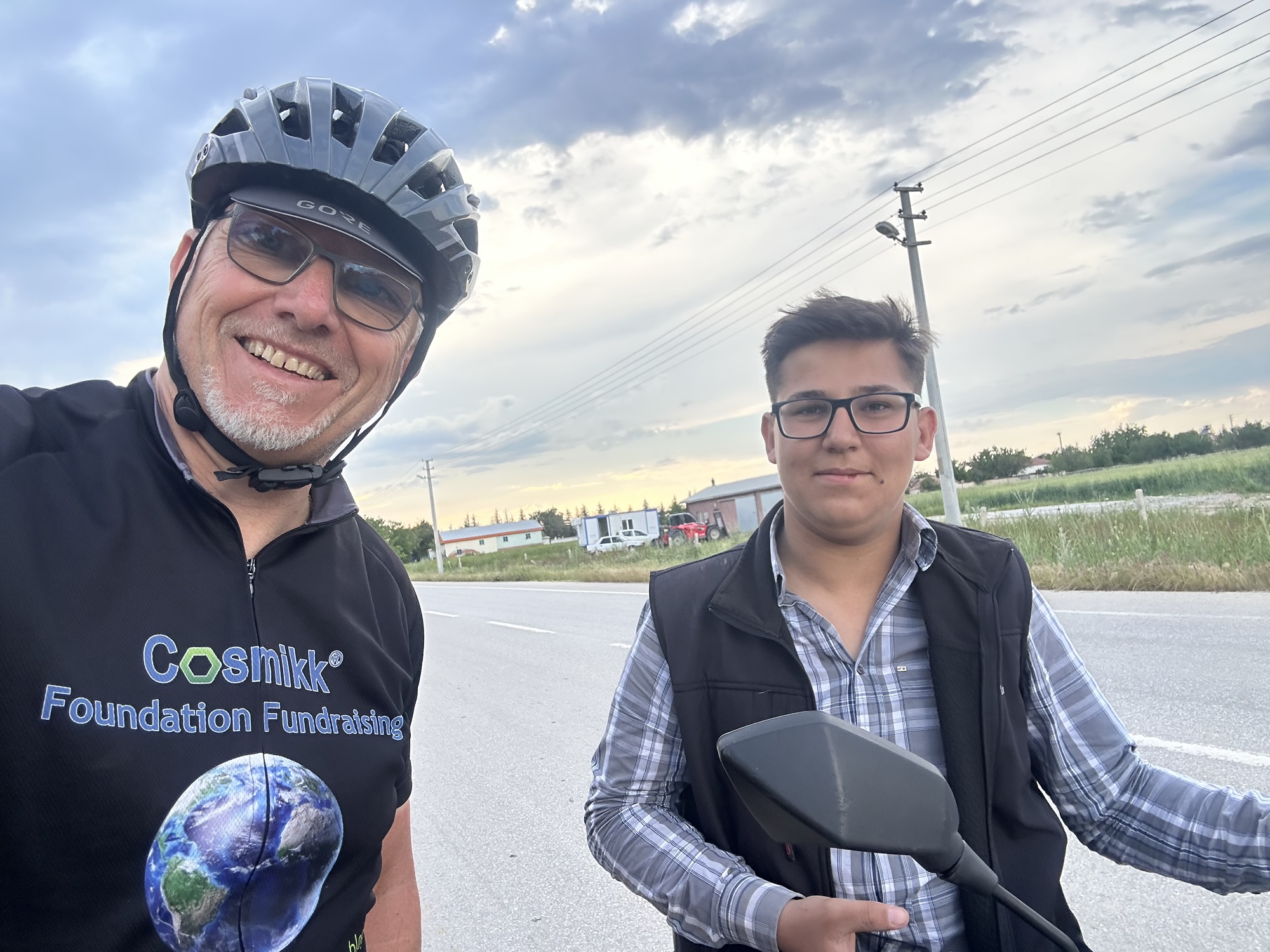
In the evening a young man came by on a scooter. He wanted to know what I was doing, where I was going, where I was sleeping. Very curious, very warm.

Like almost everyone I had met that day, he spoke no English, no German, no Russian, no Arabic. Nothing but Turkish. I had noticed schoolchildren around three or four in the afternoon, coming home in uniforms after what must be a long school day. Languages do not seem to be part of the curriculum here, at least not among the people I am meeting. I want to understand better why that is and asked Claude.
Turkey has a multi-tier school system that partly explains this. Children attend primary school followed by middle school and then either academic high school, known as a lise, or a vocational school, and the school day often runs well into the afternoon precisely because of the sheer number of subjects on the curriculum. English is officially taught from the second grade onward, but in rural areas the quality of language instruction varies enormously, teachers are scarce, and the subject rarely gets the time or priority it receives in city schools. The result is that children spend long days in uniform coming home at three or four in the afternoon, having technically studied English for years, but without ever having had a real conversation in it. In the villages I am passing through, that gap between what is taught on paper and what actually lands is very visible.
Is this negligence, different priorities, or is there a plan behind this?
There is a school of thought that says language is a gateway. English in particular opens access to the internet beyond your own language bubble, to foreign media, to job markets abroad, to ideas that arrive from outside. A population that reads and thinks only in Turkish stays more connected to Turkish sources, Turkish narratives, and Turkish economic opportunities.
Whether that is deliberate policy or simply the result of an underfunded rural education system is hard to say from the outside. What is clear is that the effect is: People stay. They farm, they work locally, they remain embedded in the community and economy they were born into.
It is worth noting that Turkey has a significant emigration problem among its educated, English-speaking urban youth. Brain drain is a real and documented concern for the government. If you can leave, some do. If you never learned the language that would let you navigate life abroad, that option simply does not exist for you.
Back to my evening. The land is very flat in this part of the country. Finding a tent spot took some effort. Like every evening I asked upstairs for guidance. I eventually settled on a small patch near a big agricultural production facility that made a constant humming sound. There was a slight dip in the field about 100m from the road where I could stay out of sight.
As the sun went down, I managed a wash, changed into civil clothes, and made dinner. I am getting better at all of it, a bit faster and a bit more effective every day. That feeling at the end of a long day on the bike, alone in open nature with a lukewarm beer and the last light fading, is not something any hotel can come close to. Not even slightly.
I was in bed by nine. Then the thunderstorm arrived. I jumped out, made sure everything was dry or covered, and went back in. I fell asleep to the sound of it. Sleep was better than the night before.
Learnings for the day. You can be an imam and a martial arts teacher at the same time. A shop does not always look like a shop. Sometimes it is just a door in the wall, and you have to look carefully. And kindness finds you in the most remote places.